
Why Do Marine Elevators Still Retain a Car-Roof Safety Hatch?
Films often show people escaping through a hatch in the roof of an elevator car. Real elevator rescue is very different. In many modern building lifts, a car-roof hatch is not provided as a routine passenger escape route. Building rescue strategies normally keep passengers inside the car while trained personnel control the equipment and open a safe exit.
A marine elevator can follow a different design philosophy. Some ship elevators still retain a car-roof safety hatch as part of a wider system of interlocks, rescue procedures and maintenance access. The reason is not cinematic tradition; it is the operational reality of a vessel that may be far from shore-based support.
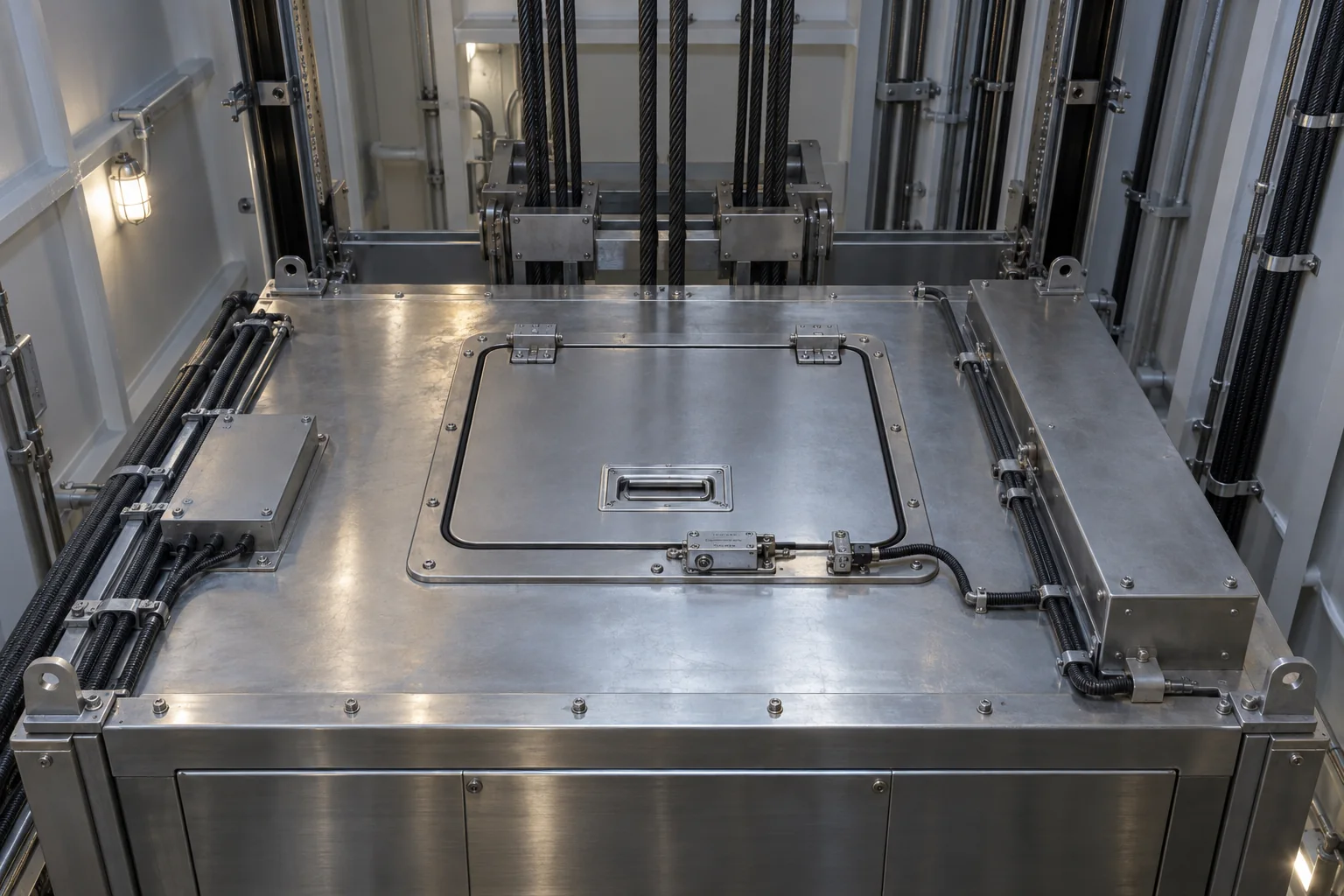
1. Why building elevators rarely rely on a car-roof hatch
Urban buildings usually have property management, elevator contractors, fire services and public emergency response. When passengers are trapped, the preferred approach is to communicate with them, stabilise and isolate the elevator, and use trained personnel to release the landing door or move the car to an authorised rescue position.
Allowing passengers to enter the hoistway can create a greater danger than remaining in the car. For that reason, many contemporary building-elevator strategies do not treat a roof hatch as a normal passenger escape route. Requirements still vary by jurisdiction, elevator type and application, so the statement should not be read as a universal prohibition.
2. A vessel may be far from shore-based elevator rescue
A ship elevator may operate for long periods aboard a container vessel, cargo ship, workboat or offshore unit. At sea, a specialist rescue team cannot simply arrive from the nearest city. Vessel motion, vibration, humidity, salt exposure and power-system changes can also complicate fault recovery.
In this setting, a properly designed hatch provides one more controlled option. If the car stops between decks or the normal landing-door route is unavailable, trained shipboard personnel can evaluate whether an alternative rescue path is appropriate. The hatch is not automatically the first choice, but operational redundancy has value when external assistance is distant.
| Design context | Typical building elevator | Marine elevator |
|---|---|---|
| External response | Property, contractor and public rescue support are normally available | At sea, the vessel initially relies on trained shipboard personnel |
| Operating environment | Fixed building with relatively stable structure and power | Vessel motion, vibration, humidity, salt and power transfer |
| Rescue emphasis | Keep passengers out of the hoistway and organise landing-door rescue | Maintain additional controlled rescue and maintenance options where approved |
3. The hatch can support a controlled evacuation
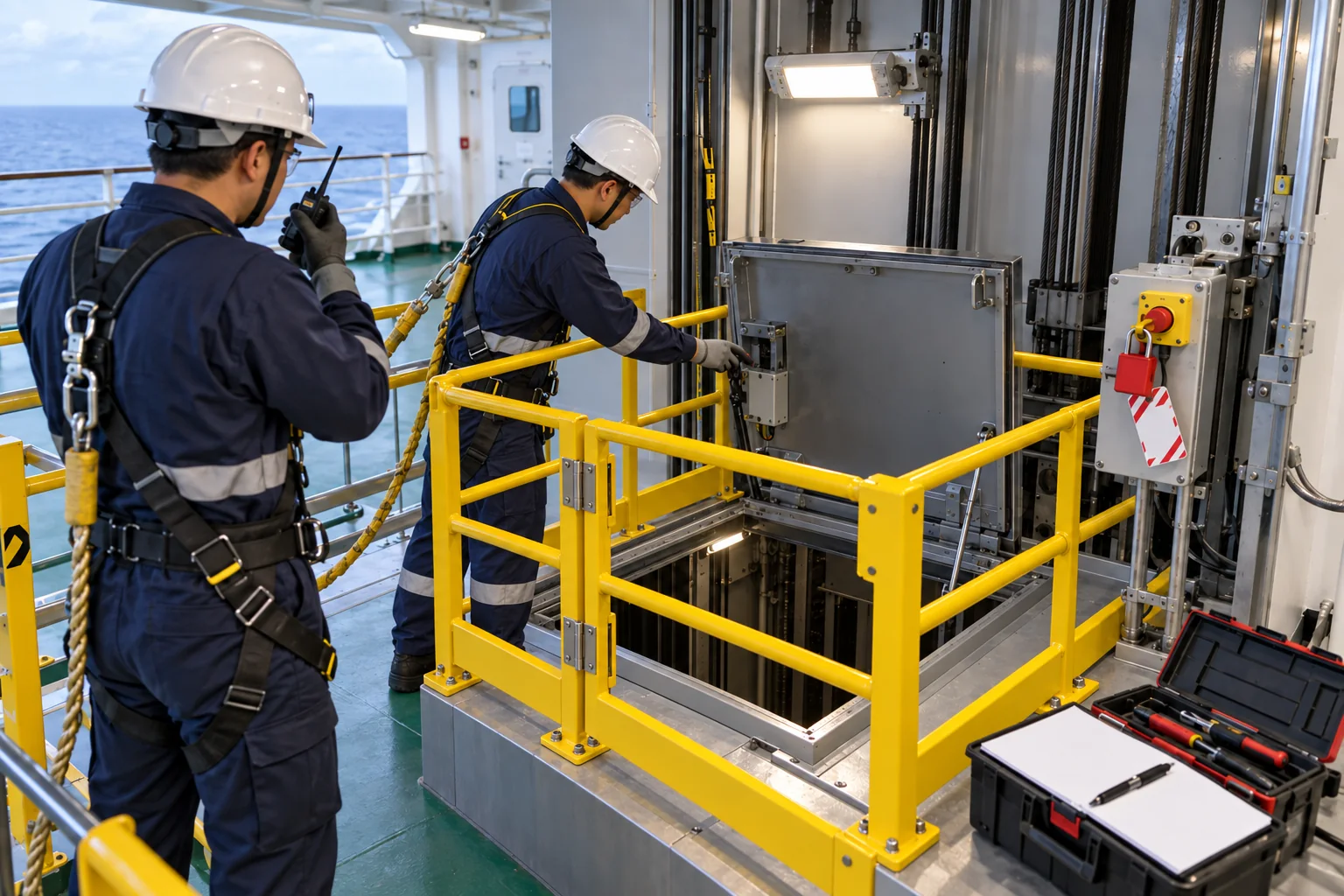
If a ship elevator stops between decks and a normal landing-door release cannot be carried out safely, the car-roof escape hatch may support an assisted evacuation. “Self-rescue” should not mean that a trapped seafarer opens the hatch and climbs into the shaft alone. It means the vessel can use its own trained personnel, communications and safety equipment to establish a controlled route.
A planned response normally confirms the number and condition of occupants, isolates the elevator, prevents unintended car movement, verifies the hatch interlock, establishes communication, installs safe access and fall protection, and assists occupants one at a time. The actual sequence must come from the approved vessel and equipment procedure, not from a film scene.
4. The safety hatch can also serve maintenance design
Space aboard a vessel is limited. The relationship between the car roof, overhead equipment, deck structure and machinery may be more constrained than in a conventional building. In some designs, the hatch therefore supports inspection, maintenance access or component approach as well as emergency planning.
During marine elevator maintenance, technicians may inspect the hatch panel, hinges, latch, corrosion protection, seal and electrical switch. Opening or unlocking the hatch should interrupt the relevant safety circuit and prevent normal elevator movement. A seized, distorted, blocked or electrically bypassed hatch may fail when it is needed most.
5. What makes a car-roof hatch a safety device?
- Secure latching: prevents unintended opening during normal operation and vessel movement.
- Electrical safety interlock: removes normal running permission when the hatch is open or not correctly locked.
- Structural strength and corrosion resistance: supports the marine vibration, humidity and salt environment.
- Usable rescue space: hatch position, clear opening and surrounding space must suit the approved rescue plan.
- Communication and reception: rescuers remain in contact with occupants, the bridge or the responsible duty station.
- Lighting and fall protection: any car-roof or hoistway work requires suitable protection for personnel.
6. What should inspection and maintenance cover?
| Item | Inspection focus | Action when abnormal |
|---|---|---|
| Hatch panel | Corrosion, distortion, looseness, sealing and obstruction | Restrict use and arrange competent assessment |
| Hinges and latch | Smooth movement and positive locking | Never force, tie or improvise the mechanism |
| Safety interlock | Correct prevention of elevator movement when open | Stop relevant operation if the interlock is unreliable |
| Rescue route | Lighting, access equipment, fall-protection points and receiving space | Restore access and update risk controls |
| Rescue procedure | Responsibilities, communication, isolation steps and drill records | Revise through the vessel's management system |
A marine elevator annual inspection or dedicated safety assessment should verify the hatch structure and interlock according to the maker's documents and applicable requirements. Corrosion repair, switch replacement, wiring changes or structural work should be completed by competent marine elevator repair personnel and function-tested afterwards.
Conclusion: the retained feature represents redundancy, not a movie escape
The car-roof safety hatch remains on some marine elevators because a vessel may be remote, its environment is complex, space is constrained and maintenance access must be planned carefully. It preserves an additional controlled path when the normal rescue route is unavailable.
Its value depends on the whole safety system: sound structure, reliable interlocks, trained personnel, clear communication, fall protection, inspection and documented procedures. Without those elements, a hatch can become another hazard rather than an additional safeguard.