
When a marine elevator fails on a foreign-flag vessel, early submission of the port window, agent details, fault evidence and technical drawings gives the best chance of completing diagnosis and repair within the call. Port access, spares and safety testing must be planned together.
01 / EMERGENCY RESPONSE
When should a marine elevator emergency response start?
Start an emergency response when the ship elevator will not run, traps a passenger, reports door-lock or safety-circuit faults, stops repeatedly, mislevels, produces abnormal noise or shows braking concerns. Marine elevator emergency repair must restore both operation and critical protective functions.
If bypassed safety circuits, unauthorised modifications or another serious hazard are found, stop the affected operation and have qualified personnel define corrective action.
02 / INFORMATION PACKAGE
What should be included in the emergency information pack?
The information pack determines the repair method, engineer allocation, instruments and spares. For marine elevator emergency repair Shenzhen attendance, identify the port area, terminal and berth as early as possible.
Vessel and schedule
Vessel name, IMO number, flag, vessel type, current or expected China port, ETA and ETD.
Local ship agent
Company name, contact person, telephone number and email for the agent at the China port.
Elevator identification
Maker, model, capacity, speed, stops and clear nameplate photographs.
Fault evidence
Symptoms, alarm code, time of occurrence, current condition, and relevant photographs or video.
Technical documents
Electrical schematics, controller and door-system drawings, manuals and parameter records.
Service history
Previous inspection and repair reports, maintenance records and recently replaced parts.
Vessel name, IMO number, flag, ETA/ETD, port and agent, fault video or code, and elevator nameplate photos. Complete drawings and service records during the remote assessment.
03 / TEN-STEP WORKFLOW
Ten-step emergency repair workflow for foreign vessels
The workflow applies to container ships, Ro-Ro vessels, bulk carriers, tankers, LNG carriers, offshore vessels, dredgers and offshore platforms. Some steps may run in parallel, but boarding approval, safety induction and acceptance testing remain essential.
Emergency request from owner or manager
Send vessel, elevator, fault and schedule information by phone, email, WhatsApp, WeChat or the website.
24/7 response
A technical contact is assigned after receipt. The response target is within 30 minutes.
Remote technical assessment
Fault codes, photos, video, drawings and service records are reviewed to identify likely causes.
Emergency repair planning
KERUI confirms engineers, instruments, common spares, major-part requirements, expected duration and schedule impact.
Boarding and port-entry filing
The ship agent coordinates foreign-vessel boarding, terminal work access, security registration and any temporary work permit.
Engineer mobilisation
Engineers travel with diagnostic instruments, specialist tools, common electrical parts, door-system spares and PPE.
Onboard troubleshooting
Mechanical, electrical, control, door and safety systems are inspected to locate the root cause.
Emergency repair
Damaged parts are replaced, electrical faults corrected, door systems adjusted, safety circuits restored and alarms reset.
Operational test and vessel acceptance
No-load, door, levelling, emergency-stop, safety-circuit and rescue-function tests are completed; load testing follows when conditions permit.
Service report
The report records fault cause, inspection scope, replaced parts, work performed and test results, with maintenance, inspection, overhaul or spares recommendations.
04 / ONBOARD WORK
What does the engineer inspect and repair onboard?
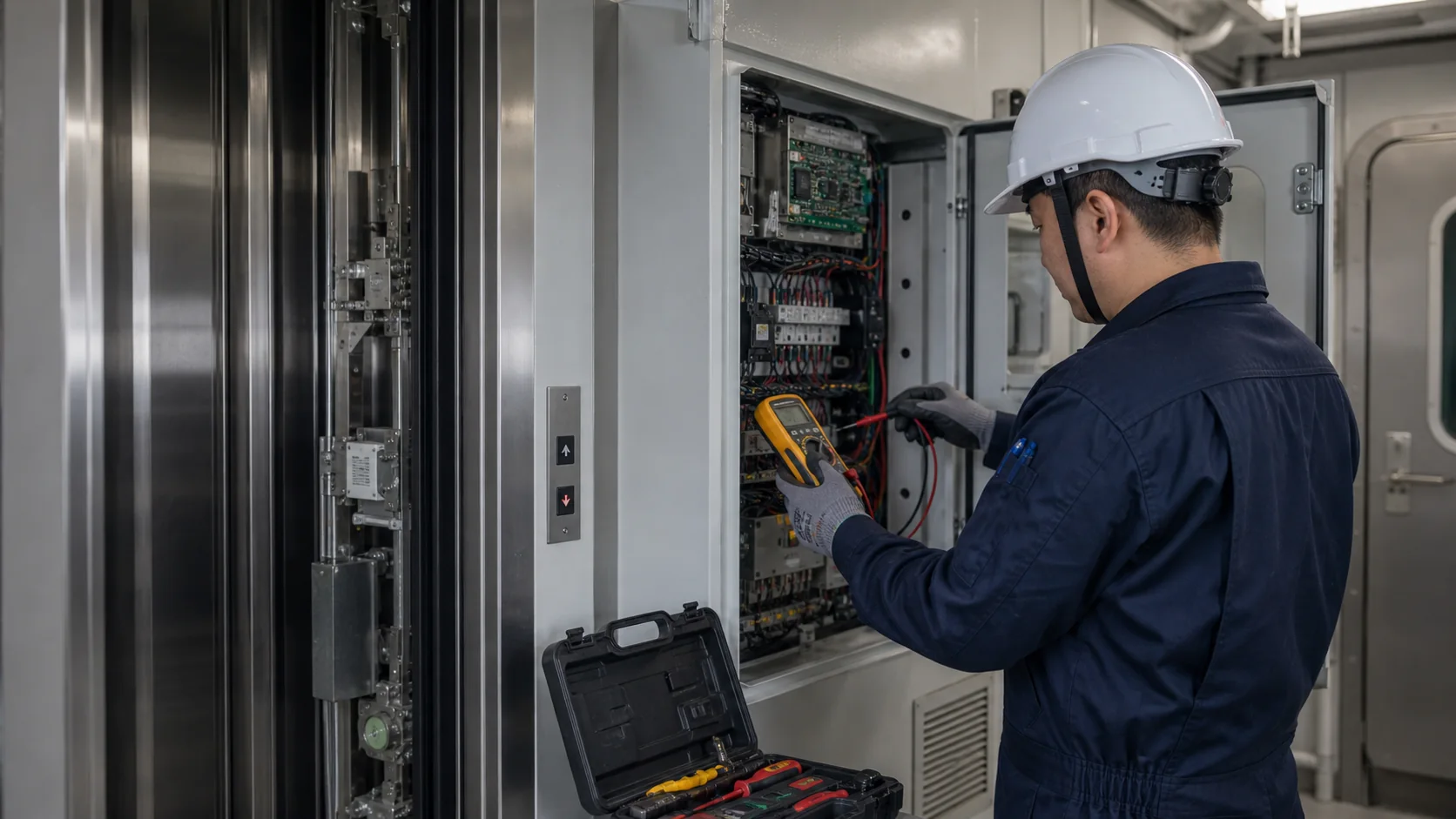
Onboard work normally covers mechanical equipment, electrical controls, doors and safety devices. A professional ship elevator repair does more than reset an alarm: it identifies the cause, restores safety functions and determines whether overhaul is required.
Mechanical and traction
Traction machine, brake, ropes, guide rails and related mechanical condition.
Door system
Door operator, locks, landing and car interlocks, opening/closing and adjustment.
Electrical and controls
Controller, PLC, contactors, power supply, wiring, parameters and fault history.
Safety protection
Safety circuit, governor, safety gear, rope gripper, emergency stop and rescue device.
05 / RESPONSE TARGETS
Emergency service response targets
These are service targets rather than unconditional guarantees. Actual timing depends on the vessel window, immigration and terminal approval, spares, travel, work permits, equipment condition and safe working conditions.
With complete records, the target is to issue the emergency repair report within 24 hours after attendance. Third-party testing, strip-down inspection or maker data may require a separately agreed schedule.
06 / CHINA PORTS
How is foreign vessel emergency repair coordinated at China ports?
KERUI coordinates foreign vessel emergency repair China ports coverage around the vessel schedule, including Shenzhen, Guangzhou, Shanghai, Ningbo, Zhoushan, Qingdao, Yantai and Sanya. Immigration, security, terminal access and tool declarations differ by port, so the vessel should nominate a local ship agent as the formal coordination contact.
Shenzhen and Guangdong ports
- Confirm Shekou, Chiwan, Mawan, Nansha or the exact terminal and berth;
- Send the vessel and agent package for marine elevator emergency repair Shenzhen;
- Have the agent confirm boarding gate, immigration and terminal work access.
Shanghai and other China ports
- Provide accurate ETA/ETD updates throughout the call planning;
- Confirm declaration rules for tools, instruments and spares;
- Reserve time for safety testing, vessel acceptance and report records.
07 / FAQ
Frequently asked questions
Can the response start before the vessel arrives?+
Yes. Send the flag, ETA/ETD, expected port, agent contact, fault code and video. Early remote assessment helps prepare engineers, tools and likely spares before arrival.
How is marine elevator emergency repair Shenzhen arranged?+
After the Shenzhen terminal and berth are confirmed, the ship agent coordinates boarding and port access. KERUI allocates engineers, instruments and common spares around the vessel window.
Can a foreign vessel receive same-day attendance at every China port?+
Not automatically. Attendance depends on the vessel schedule, agent coordination, immigration and terminal approval, work windows and engineer travel. Submit the emergency package as early as possible.
Will one attendance always restore the elevator?+
Many common faults can be resolved in one attendance when the correct parts, safe work conditions and time window are available. Major component damage, control-system faults or serious safety risks may require a dedicated plan, a second attendance or overhaul.
24/7 MARINE ELEVATOR RESPONSE
Is your foreign-flag vessel calling at a China port? Send the schedule and fault evidence now.
KERUI supports remote assessment, marine elevator emergency repair, onboard inspection, safety testing, spares and follow-up inspection or overhaul planning.
Source and scope note
This article is based on KERUI's foreign-flag vessel emergency elevator repair process and practical coordination requirements for attendance at China ports.
Port access, immigration, security and work-permit requirements may change. Follow the latest instructions from the ship agent, terminal and port authorities. Images are original illustrations and do not depict a specific vessel or project.