
Why Many Ship Elevators Use PLCs and VFDs: Reliability Matters More Than Appearances
Many marine elevators use a control architecture built around a programmable logic controller (PLC) and a variable-frequency drive (VFD). Compared with highly integrated, elevator-specific platforms, this arrangement may look less sophisticated. Yet its functions are easy to understand, its components are widely supported, and technicians can often isolate faults by system layer. On a vessel operating far from shore, that practical serviceability matters. The equipment must contend with heat, humidity, salt-laden air, vibration and shipboard power variations—conditions in which predictable operation and repair access can be more valuable than extra features.
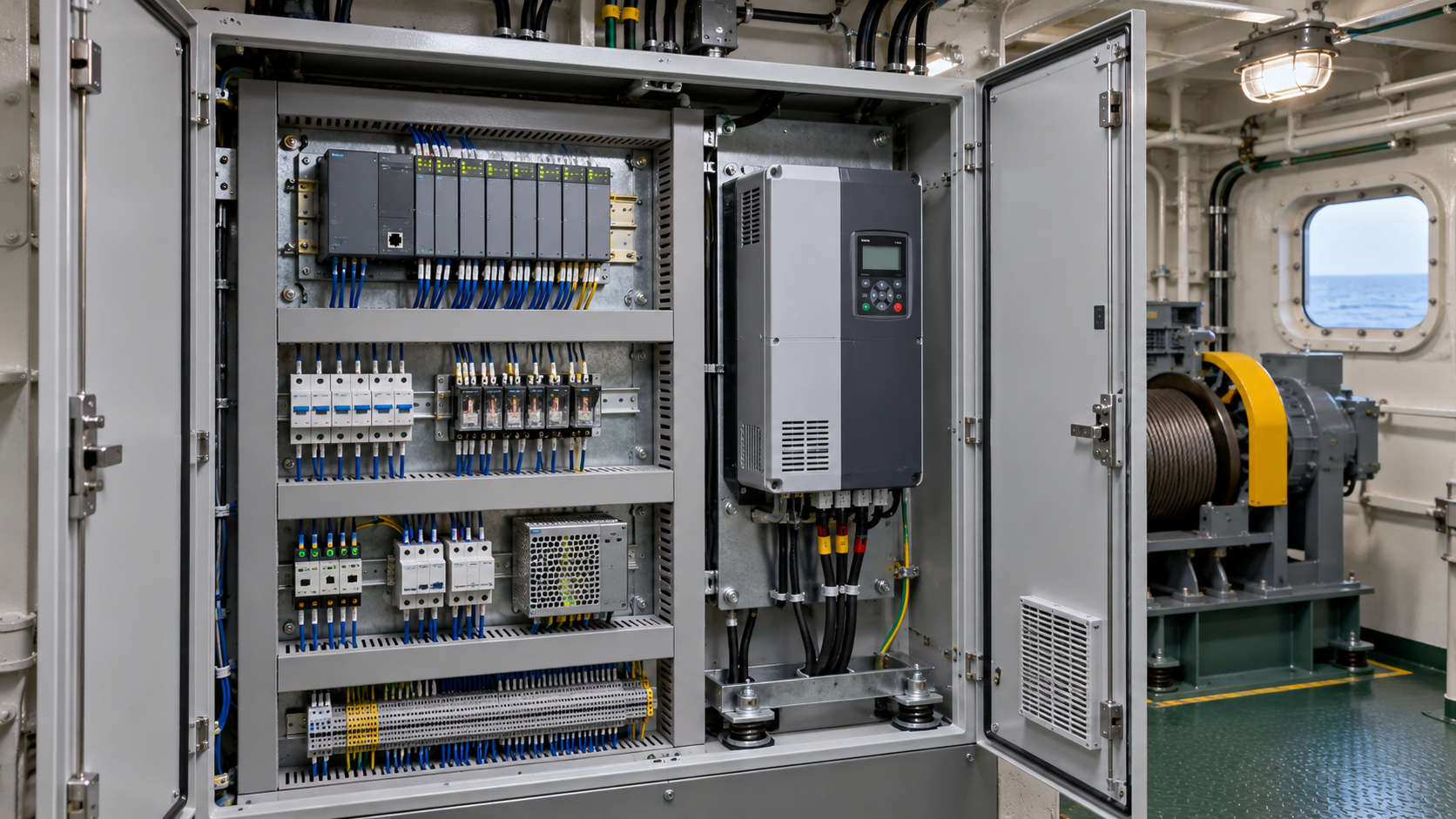
What do the PLC and VFD do?
The PLC is the logic controller. It processes calls, position and door-status signals, then manages the sequence of operation and exchanges commands with the drive. The VFD adjusts motor output so the traction machine can start, accelerate, decelerate and level according to configured motion profiles.
Door interlocks, emergency stops, limits, brake monitoring, inspection controls and rescue functions are also part of the elevator’s protection and operating design. How these functions are implemented varies. A standard PLC must not automatically be treated as a safety controller: the safety chain, safety relays or certified safety controller must remain consistent with the approved design and applicable requirements. Never bypass a safety circuit to simplify troubleshooting.
Why is the marine environment demanding?
- Heat and restricted airflow: machinery spaces can run hot. Drives and control components need suitable cooling, clearances and environmental derating.
- Humidity and salt: condensation and salt deposits can accelerate corrosion at terminals, contacts and wiring. Enclosure protection, sealed cable entries, anti-condensation measures and periodic cleaning all matter.
- Vibration and vessel motion: loose terminals, connectors or mountings may develop intermittent faults over time, so secure installation and inspection are essential.
- Variable power quality: voltage variation, frequency changes or transients can affect controls and drives. Supply, grounding, shielding and protection should be checked against the vessel’s electrical system.
- Limited repair resources at sea: a replacement board or factory service may not be available during a voyage. Accurate drawings, fault records and obtainable spare parts reduce diagnostic delays.
Practical strengths: clear functions and serviceable components
PLC and VFD functions are often divided into identifiable modules. With a fault history, electrical drawings, PLC input/output status, drive alarms and appropriate measurements, a technician can narrow the problem to supply, control signals, interlocks, drive, motor or mechanical equipment. This structured approach can prevent unnecessary board replacement and help the owner plan a sensible spare-parts inventory.
However, a simple architecture is not automatically reliable. Incorrect component selection, insufficient cabinet cooling, poor grounding or shielding, missing program backups and undocumented wiring can all undermine performance. Reliability comes from marine-suitable engineering, sound installation, commissioning, environmental protection and ongoing maintenance—not from the PLC label alone.
A practical maintenance checklist
| Area | What to review | When an issue is found |
|---|---|---|
| Cabinet environment | Temperature, airflow filters, condensation protection, moisture or salt traces | Find the source of ingress or heat before correcting it; do not block required ventilation |
| Terminals and wiring | Looseness, heat discoloration, corrosion, wire labels and drawing accuracy | Isolate power and repair or tighten only under qualified procedures and manufacturer guidance |
| PLC and drive | Fault history, operating status, parameter and program backups, alarms | Record the code and operating condition, then trace the circuit methodically |
| Brake and safety functions | Brake action, door interlocks, safety chain, limits and inspection controls | Test under the prescribed procedure; never leave a bypass in service |
| Documents and spares | Current wiring diagrams, PLC backup, VFD parameters and part references | Reconcile the as-built documents with the installed equipment and keep readable copies onboard |
When should an owner repair or modernize the control system?
For a sensor, wiring, cooling, parameter or individual component problem, first identify the root cause from the drawings and fault history. A local fault does not automatically mean the whole control system is obsolete. If the PLC, VFD or proprietary board is discontinued, repeatedly failing without dependable spares, or no longer supported—and the original program or technical files are unavailable—the owner may assess repair, replacement or a marine elevator control-system modernization.
Before changing the system, document the elevator model, capacity, speed, landings, traction machine, brake, safety devices, door equipment, signal interfaces, ship supply and environmental conditions. Agree the scope with the owner, manufacturer and relevant flag or class organization. Any replacement must verify safety functions, emergency rescue, operation and handover documentation. Modernization should not be driven by “smart” features alone when the existing system is stable and serviceable.
Conclusion: modernization is not about adding complexity
The value of a marine elevator controller is measured by safe, predictable operation in the vessel’s real environment. A mature PLC-and-VFD arrangement is not inherently outdated. With proper marine environmental design, installation, commissioning and documentation, it can provide a transparent, maintainable control platform. When selecting or renewing a system, assess reliability, repairability, spare-part availability and compliance first; consider additional features only when they serve a genuine operational need.
KERUI can assist vessel operators with marine elevator fault diagnosis, annual inspection, control-system repair and modernization assessment. Scope is confirmed against the port call, vessel schedule, flag, equipment records and onboard findings.
This article is general technical information, not a design, repair or modernization instruction for a specific vessel. Before work, complete a risk assessment, isolate power and follow shipboard safety procedures, manufacturer documentation and applicable regulations or class requirements.