
Marine Elevator Modernization: Reliability Before “Advanced” Technology
When a ship elevator control board is damaged beyond reliable repair, discontinued or no longer supported, repeated patch repairs and uncertain second-hand boards rarely provide a sustainable answer. A focused marine elevator modernization can retain verified serviceable mechanical equipment while replacing the unsupported control section with a system that is stable, testable and maintainable.
The objective is not digitalisation for its own sake. A ship elevator works far from shore and is exposed to vibration, humidity, salt-laden air, temperature change and shipboard power conditions. The owner needs predictable operation, understandable faults, obtainable spare parts and complete documentation—not unnecessary screens, cloud functions or proprietary complexity.
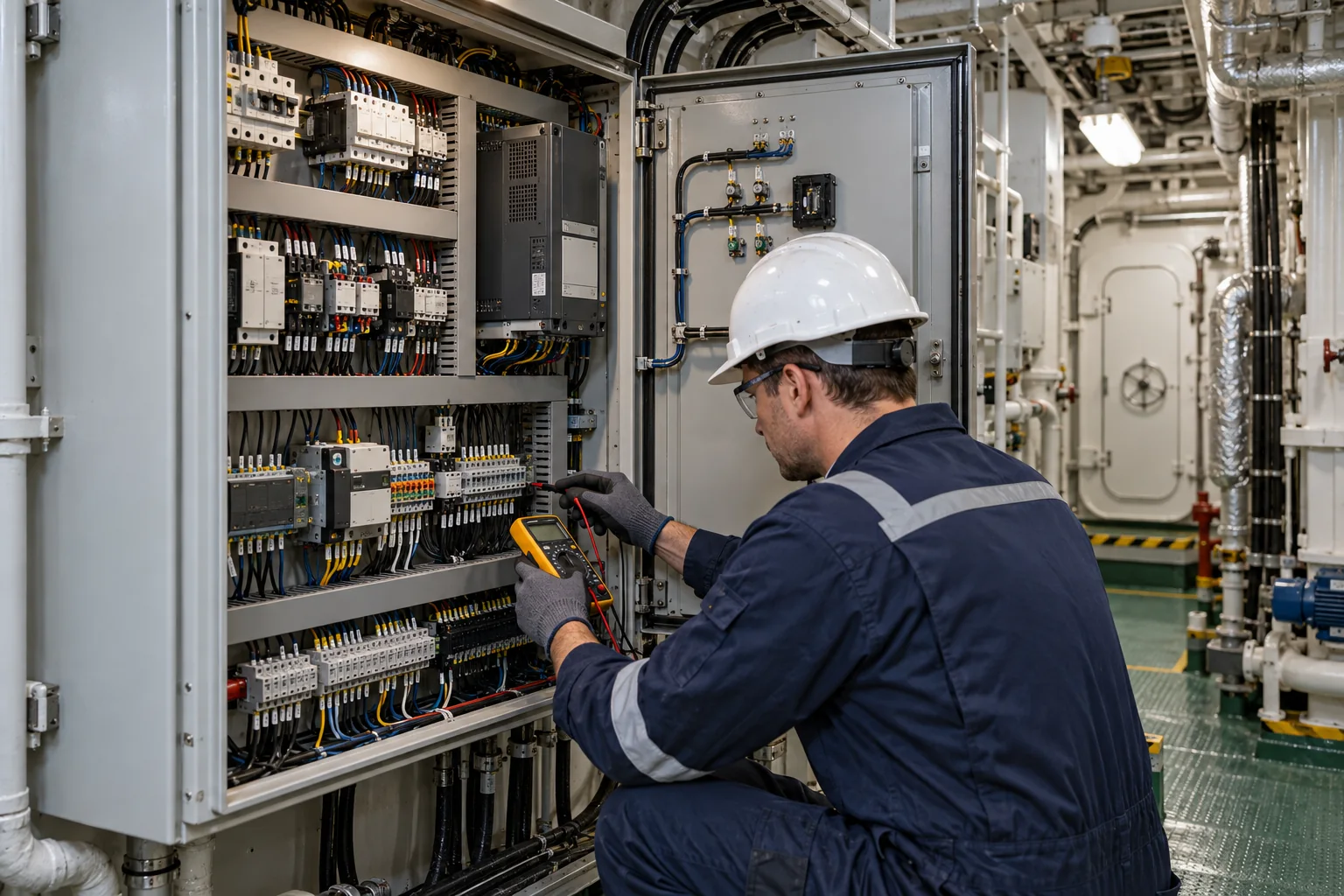
1. When should a control-system replacement be considered?
A failed PCB does not automatically justify replacing the entire lift. A competent survey should first confirm whether the board is the root cause and whether power supply, sensors, safety contacts, brake or door equipment have contributed to the failure. The team can then compare repair, genuine replacement and a controlled ship elevator controller retrofit.
| Condition | Risk of repeated repair | Modernization objective |
|---|---|---|
| Original PCB is obsolete with no dependable stock | Every failure depends on used parts of uncertain history | Establish a supportable platform and documented spares |
| Board is badly burnt or repeatedly repaired | Tracks, connectors or embedded logic may remain unreliable | Map all I/O, safety functions and drive interfaces |
| Software, password or service tool is unavailable | Parameters cannot be restored and faults cannot be diagnosed | Deliver accessible parameters, backups and technical records |
| Proprietary parts have excessive lead time | A minor fault can immobilise the lift for an entire voyage cycle | Use clearly specified industrial components with stable supply |
2. Reliability first—do not add complexity without a duty
A successful marine elevator control panel replacement is not measured by the number of touchscreens, network links or “smart” functions. Every additional communication layer, specialist application and closed software dependency can become another failure point and another barrier to future service.
The new controller may use mature current industrial technology, but its architecture should remain transparent. Safety circuits must be clearly defined, I/O must be traceable, parameters must be backed up, fault codes must be understandable and essential service must not depend on an external network. Features should stop where the operating, safety, maintenance and class requirements are satisfied.
Modernization should make the marine elevator easier to keep in service—not merely make it look newer.
3. Why an obsolete board cannot simply be rewired terminal for terminal
The old controller interfaces with landing-door locks, governor and safety-gear switches, terminal limits, brake circuits, door operator, levelling sensors, car-top inspection controls, pit stop devices, alarm and emergency communication. A replacement platform may use different signal voltages, contact logic, monitoring methods and fault responses.
An obsolete elevator control board replacement therefore needs an interface schedule and functional matrix before panel design. Blind wire-for-wire substitution can omit a safety function or create incompatible signals. The design review should identify:
- rated load, speed, stops, drive type and operating sequence;
- every safety device, circuit, actuation condition and reset method;
- traction machine, brake, encoder, drive and power data;
- door operator, interlocks, levelling, indicators, buttons, alarm and communication interfaces;
- expected behaviour in normal, inspection, emergency and loss-of-power conditions;
- shipboard power, EMC, vibration, humidity and installation-space constraints.
4. What does a more universal system actually mean?
Universal does not mean fitting ordinary building-lift components without verification, and it never means bypassing class or manufacturer requirements. It means reducing unsupported single-source parts while retaining the environmental rating, electrical compatibility, safety integrity and approvals required for the vessel.
| Area | Practical approach | Essential control |
|---|---|---|
| Logic platform | Select a mature industrial solution with long-term supply and support | Define software version, parameter ownership, access and backup |
| Low-voltage components | Use clearly specified contactors, relays, power supplies and terminals | Match ratings, coil voltage, environment and fault protection |
| Drive and feedback | Use supportable drives and encoders only where compatibility is proven | Jointly validate machine, brake, feedback and EMC behaviour |
| Door and push-button interfaces | Prefer products with documented interfaces and obtainable parts | Do not compromise door-lock safety or enclosure protection |
| Technical file | Deliver schematics, I/O schedule, parameters, spares and fault guidance | Keep the onboard copy aligned with the as-built system |
5. What can be retained and what should be replaced?
Scope should follow inspection and measurement, not age alone. The traction machine, rails, car, counterweight, landing doors, locks, governor, safety gear, buffers and ropes may be retained only after their condition, performance and suitability are verified. Damaged, corroded, worn or incompatible components need repair or replacement.
If the unsupported PCB is the principal defect, the work may focus on the controller, drive and essential interfaces. If the door controller, encoder, brake unit or position system is also obsolete, the project should address those dependencies together so the new controller is not tied to the next unavailable component.
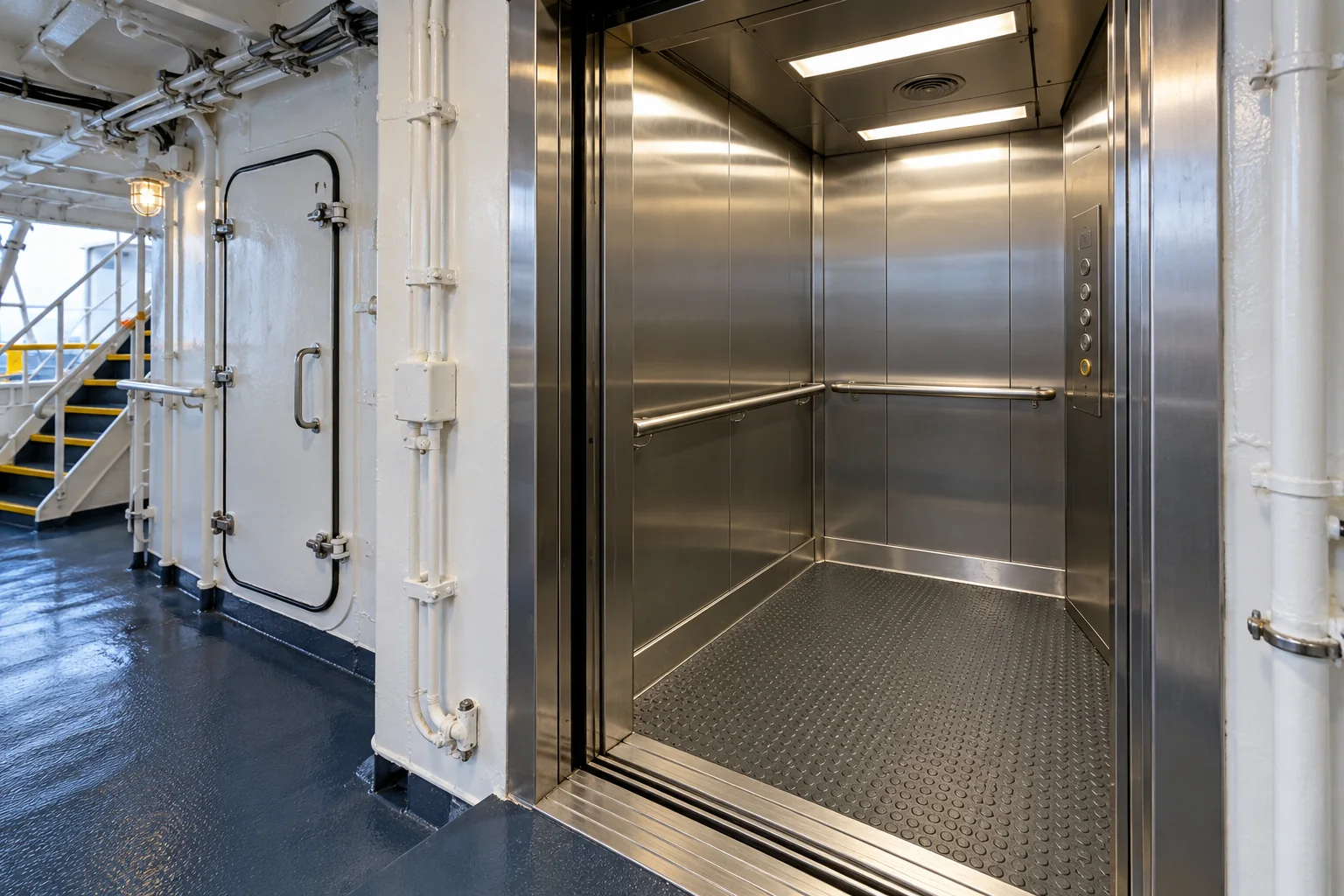
6. A controlled modernization workflow
- Survey: review faults, drawings and service history; verify nameplates, wiring, interfaces and mechanical condition.
- Define scope: list retained, repaired and replaced items; prepare the risk register, I/O schedule and functional matrix.
- Technical review: confirm the approval route against flag, class, applicable rules and owner requirements.
- Design and manufacture: complete panel design, component selection, terminal references, software and parameters; simulate functions before delivery where practical.
- Onboard installation: isolate power, document the old system, verify cables, install the panel and interfaces, and record every modification.
- Commission and test: prove safety circuits, locks, brakes, levelling, inspection controls, final limits, alarm and rescue functions; complete operational and load tests where applicable.
- Handover and training: supply as-built drawings, backups, spares, test records and maintenance instructions; train crew and service personnel.
7. What should the acceptance check confirm?
- All safety functions remain consistent with the approved design and applicable requirements.
- Normal, inspection, fault and emergency behaviours are defined and repeatable.
- Starting, deceleration, levelling and door operation remain stable on the vessel's actual power supply.
- Components and terminals are identified and the schematic matches the installed system.
- Software and parameters are backed up, with fault guidance and part specifications available onboard.
- Required plan approval, witness testing and documentation for flag, class or the relevant inspection body are complete.
8. KERUI's approach to marine elevator modernization
KERUI can support owners facing a damaged, obsolete or unsupported control board with system surveys, fault-boundary assessment, control-panel modernization, maintainable spare-parts planning, onboard installation, commissioning, testing and technical-file preparation. Our focus in marine elevator repair is long-term availability, not unnecessary connectivity or feature count.
Every vessel has a different original system and approval basis. The final scope must follow an onboard survey and be agreed with the owner, manager and relevant flag or classification body before implementation.
References and scope
ISO 8383 addresses specific requirements for the design, installation and inspection of lifts on ships and notes that requirements applicable to the individual vessel and lift safety codes must also be followed. Lloyd's Register includes passenger and service lifts within its marine lifting-appliance rules framework. This article explains an engineering approach; it does not replace plan approval, classification or statutory inspection.