
Elevator Balance Factor Explained: Purpose, Testing and Effects on Operation
During building elevator commissioning, inspection and modernization, the elevator balance factor is a frequently used—but often misunderstood—technical value. It describes how the counterweight relates to the car's own mass and rated payload, and therefore how traction-system load is distributed across different loading and travel conditions. Understanding it helps engineers interpret commissioning data, energy use and ride behaviour. It is not a stand-alone performance setting and must not be adjusted outside the manufacturer's design and applicable rules.
1. What does the balance factor mean?
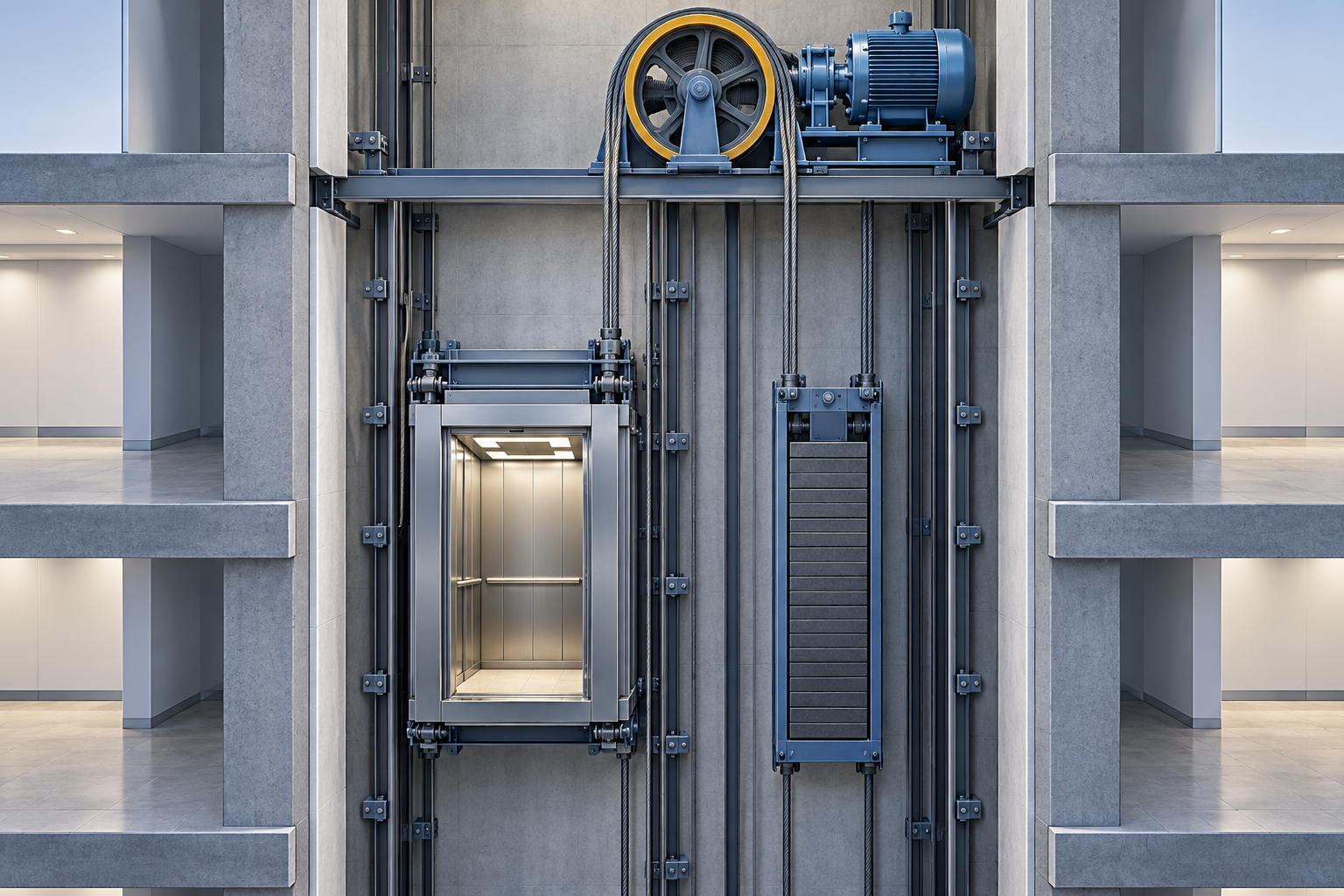
In a traction elevator, the counterweight does more than simply “balance the car.” It compensates for the car's own mass and offsets part of the rated payload. A commonly used mass relationship is:
Here W is the counterweight-system mass, G is the car-system mass, and Q is rated load. System boundaries may be described differently in some documents, so engineering work should use the manufacturer's definitions and the applicable inspection rule.
For example, a design balance factor of 0.45 means, in simple terms, that the counterweight is about 45% of rated load heavier than the empty car system. Near that payload, a simplified static model shows a smaller mass difference between the car and counterweight sides. Actual operation is also affected by suspension and compensation equipment, friction, acceleration, drive control and mechanical condition; the formula alone cannot predict current draw or ride quality for a specific trip.
2. Why does an elevator need a balance factor?
A traction elevator transfers drive force through friction between the traction sheave and suspension ropes. The counterweight helps the drive operate with an appropriate torque and traction condition across normal loading conditions. Design and installation need to account for car mass, rated load, counterweight configuration, travel height and suspension or compensation equipment.
- It defines load distribution: the design value expresses the relative mass on the car and counterweight sides at empty and loaded conditions.
- It affects drive loading: if the balance point differs from the design, the drive sees a different load across loading and travel directions.
- It is part of system matching: traction, braking, drive parameters and protective devices must be verified together with the elevator design; a compliant balance factor does not automatically prove those items are compliant.
- It supports commissioning and inspection: the result helps confirm that the installed counterweight and car mass agree with the design file, particularly after interior changes.
3. How is the balance factor tested?
The test method and load points depend on the applicable rule, elevator type, inspection category and manufacturer's requirements. Under specified mainland-China traction-elevator supervision-inspection cases, multiple percentages of rated load are placed in the car and the elevator is run in both directions. Motor current (and voltage for certain DC motors) is measured when car and counterweight are at the same elevation. The intersection of the up- and down-run curves is used to determine the balance factor, which is then checked against the applicable range and manufacturer's design value. For periodic inspection, current rules determine whether the value is confirmed or tested; a change in car, counterweight or compensation-system mass that may affect the result can require a new test.
| Stage | Professional focus | Common mistake |
|---|---|---|
| Before testing | Confirm model, rated load, design factor, inspection rule, load and instrument requirements | Choosing one load point from habit without checking the design or rule |
| Loaded runs | Apply the prescribed loads and record direction, position, operating condition and drive readings | Unqualified staff adding weights or testing under unsafe conditions |
| Data assessment | Evaluate the up/down data using the required method and compare with both limits and design value | Treating one current reading, an unloaded power result or a “smooth ride” as a formal result |
| Records | Retain loads, readings, instrument details, curves, result and corrective actions | Recording only a final percentage without traceable supporting data |

4. Relationship to energy, ride quality and reliability
The balance factor is one input to traction-load distribution. It is not accurate to say “a higher factor always saves energy” or “a value within the range guarantees a smooth ride.” Elevator energy also depends on traffic frequency and direction, average loading, speed, travel height, drive efficiency, regenerative operation, standby controls and maintenance condition. Any balance adjustment must first meet the design and safety requirements; it must not optimize one direction or load at the expense of other operating conditions.
If an elevator starts heavily, draws unusual current under certain loads, or has levelling or comfort issues, balance factor can be one item on the diagnostic list. Engineers also need to assess drive settings, brake condition, sheave and rope condition, rails and guides, door operator, encoder feedback and supply quality. Passenger impression, a single current reading or one fault code is not enough to justify adding or removing counterweight.
5. When should the balance be reviewed?
- The car interior, floor, ceiling or other fixed parts have gained or lost significant mass.
- Counterweight blocks, frame or retaining structure have been changed, repaired or replaced.
- Suspension ropes, compensation ropes/chains or other mass-affecting components have been replaced or modified.
- The drive, traction system or car structure has undergone modernization.
- A new load-related operating anomaly makes verification appropriate after routine troubleshooting.
These conditions do not mean that site staff should adjust counterweights immediately. First compare the configuration sheet, manufacturer design and modification record; a competent professional can determine whether testing or adjustment is required and what approvals apply.
6. Installation, maintenance and overseas project considerations
During elevator installation, verify the actual car mass, counterweight configuration and design records, and retain commissioning measurements. Before later interior renovation, estimate the added mass and confirm it with the manufacturer or maintenance engineer. Routine maintenance should not alter counterweight to mask a brake, guide, traction or control problem.
For elevator export and overseas building projects, define rated load, design balance-factor range, counterweight construction and commissioning responsibility in the technical agreement. Confirm local inspection requirements, how test loads will be obtained, instrument capability and personnel qualification. Inspection periods, witnessed procedures and accepted criteria vary between countries, so export configuration and local acceptance conditions should be reviewed together.
Conclusion
The elevator balance factor is an important traction-system design and commissioning value. It represents how the counterweight offsets the car's own mass and a portion of rated payload. Good management requires accurate equipment records, prescribed measurements and a systems-level review of drive, brake, suspension and operating conditions. For building elevator sales, installation and overseas delivery, keeping the design value, as-installed configuration and maintenance handover aligned is more useful than pursuing one number in isolation.
References
- China State Administration for Market Regulation: announcement issuing TSG T7001—2023, Elevator Supervision Inspection and Periodic Inspection Rules.
- Gansu metrology technical specification JJF (Gan) 0079—2024, Calibration Specification for Elevator Balance-Factor Testers, providing terminology and instrument-calibration context.
This article is technical education, not a substitute for manufacturer instructions, statutory inspection or site engineering judgement. Testing and adjustment must be carried out by competent professionals under the applicable rules.