
Elevator Load Testing Explained: Why 100% and 125% Rated-Load Tests Matter
Elevator load testing is often reduced to “a 100% test” versus “a 125% test.” These are not simply normal loading and overload operation. Different loads, speeds, directions and brake conditions examine different functions. Understanding the distinction between a 100% rated-load elevator test and a 125% rated-load elevator test helps owners, facility teams, purchasers and service providers plan the right test and interpret its report without confusing rated-load operation, overload protection and brake testing.
1. What do 100% and 125% actually mean?
A 100% rated load means the test load equals the rated capacity stated on the elevator nameplate. A 125% rated load means the test load is 1.25 times that capacity. The percentage alone does not define the test. The elevator type, test objective, car condition, speed, direction, brake or power-cut condition, observations and post-test checks must also be specified.
Therefore, a report stating “100% passed” or “125% completed” should be read together with the exact test item. A full-load run, a grouped-brake test, a traction-capability test, a 125% rated-load brake test and an overload-protection test are distinct items; one cannot automatically substitute for another.
2. The 100% rated-load test: performance at the rated operating condition
Rated-load operation can be used to observe how the elevator behaves at its designed rated capacity—for example, starting, acceleration, travel, deceleration, leveling and signal-system response. A run test evaluates coordinated operation under its prescribed conditions. Exact travel, direction and recording criteria depend on the applicable inspection procedure and the elevator documentation.
Under China’s current TSG T7001—2023, rated load is also used for a grouped-brake test. With rated load in the car traveling downward at rated speed, a specified group of electromechanical brake components is treated as failed; the remaining braking components must decelerate and stop the car and hold it at rest. This examines brake-system redundancy. It is not the same as an ordinary full-load up-and-down run.
- Rated-condition behavior: observe operating, leveling and system behavior that may only appear under load.
- Brake capability: in the prescribed grouped-brake condition, verify that the remaining brake components can stop and hold the car.
- Baseline records: document the test load, equipment condition, measurements and corrective actions for future inspection and maintenance.
3. The 125% rated-load test: prescribed evidence of braking and traction capability
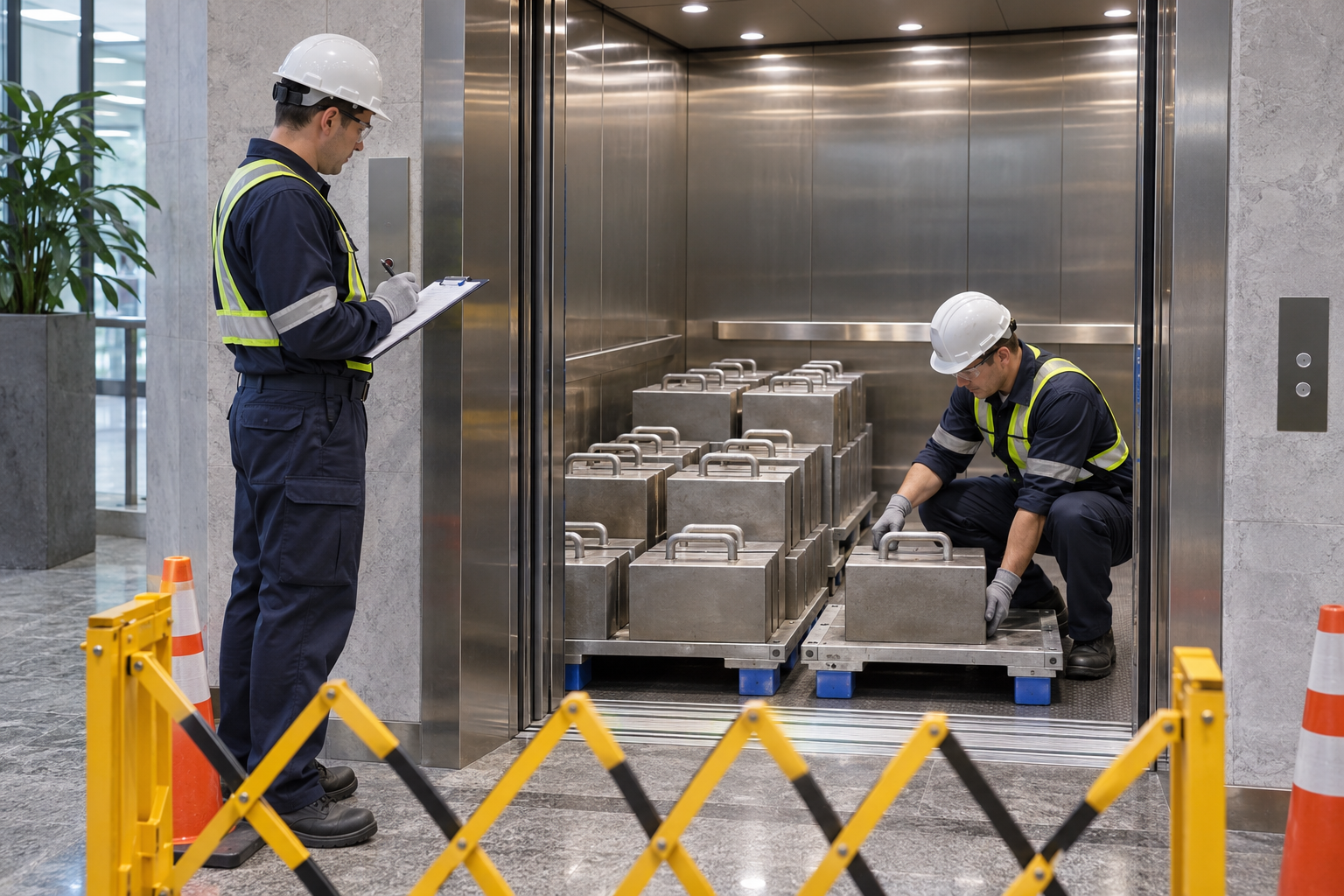
A 125% rated-load elevator test does not authorize an elevator to carry 125% of its rated capacity in normal service. It uses a test load in a prescribed procedure to verify brake performance or traction capability. For example, TSG T7001—2023 describes a 125% rated-load brake test in which the car travels downward at rated speed toward the lower part of the travel; motor and brake power are then cut as specified. The inspection checks whether the brake stops the drive machine and whether the car, attached components and guide rails show obvious deformation or damage. A separate loaded traction-capability test also uses a prescribed 125% load condition.
The purpose is not to “add more weight and see what breaks.” Under controlled conditions, it provides evidence about safety margin and critical braking or traction functions. The load must be accurate and properly distributed, instruments and records must be reliable, and shutdown, access control, team roles, emergency response and post-test inspection must all be planned.
- It can help identify insufficient brake force, inconsistent brake-component condition or related faults.
- It assesses braking and traction response under the specified above-rated test condition and informs evaluation of stopping capability and mechanical condition.
- It creates traceable evidence for inspection, maintenance and risk management.
4. Key differences between 100% and 125% tests
| Comparison | 100% rated-load tests | 125% rated-load tests |
|---|---|---|
| Load meaning | Equals the elevator’s nameplate rated capacity | 1.25 times rated capacity, only for applicable prescribed tests |
| Typical objective | Rated-condition operation; prescribed grouped-brake capability | Braking, stopping or traction capability under specified conditions |
| Not equivalent to | A full-load run alone does not prove every safety component has passed load testing | Does not permit overloading in service and is not an overload-protection test |
| Report should state | Test item, load, speed/direction, observations and measurements | Load and test condition, brake/traction response, abnormalities and post-test checks |
Do not confuse either test with an elevator overload-protection test. China’s TSG T7001—2023 includes criteria related to detecting overload no later than the specified threshold (up to 110% rated load in the cited rule). This serves a different purpose from the 125% brake or traction test.
5. Test intervals are not universally “every five years”
Intervals depend on the country or region, elevator type, inspection category and triggering conditions. As one current China example, TSG T7001—2023 specifies that, for certain traction passenger elevators and firefighter elevators subject to the rule, the 125% rated-load brake test is performed in the 18th year from the qualifying installation or applicable modernization inspection, and every six years thereafter. A 2024 implementation notice clarifies that subsequent test years are counted from the year of the most recent test.
These provisions may differ from earlier rules, local campaigns or requirements in other countries. Owners should check the elevator’s registration, latest inspection and test records, applicable rules and local authority instructions rather than infer an interval from an old report or a generic web article. Modernization, changes to major components or abnormal events may also require additional assessment.
6. Before and after an elevator load test
- Review documentation: rated capacity, elevator type, drive/brake configuration, manufacturer test procedure, applicable rule and service history.
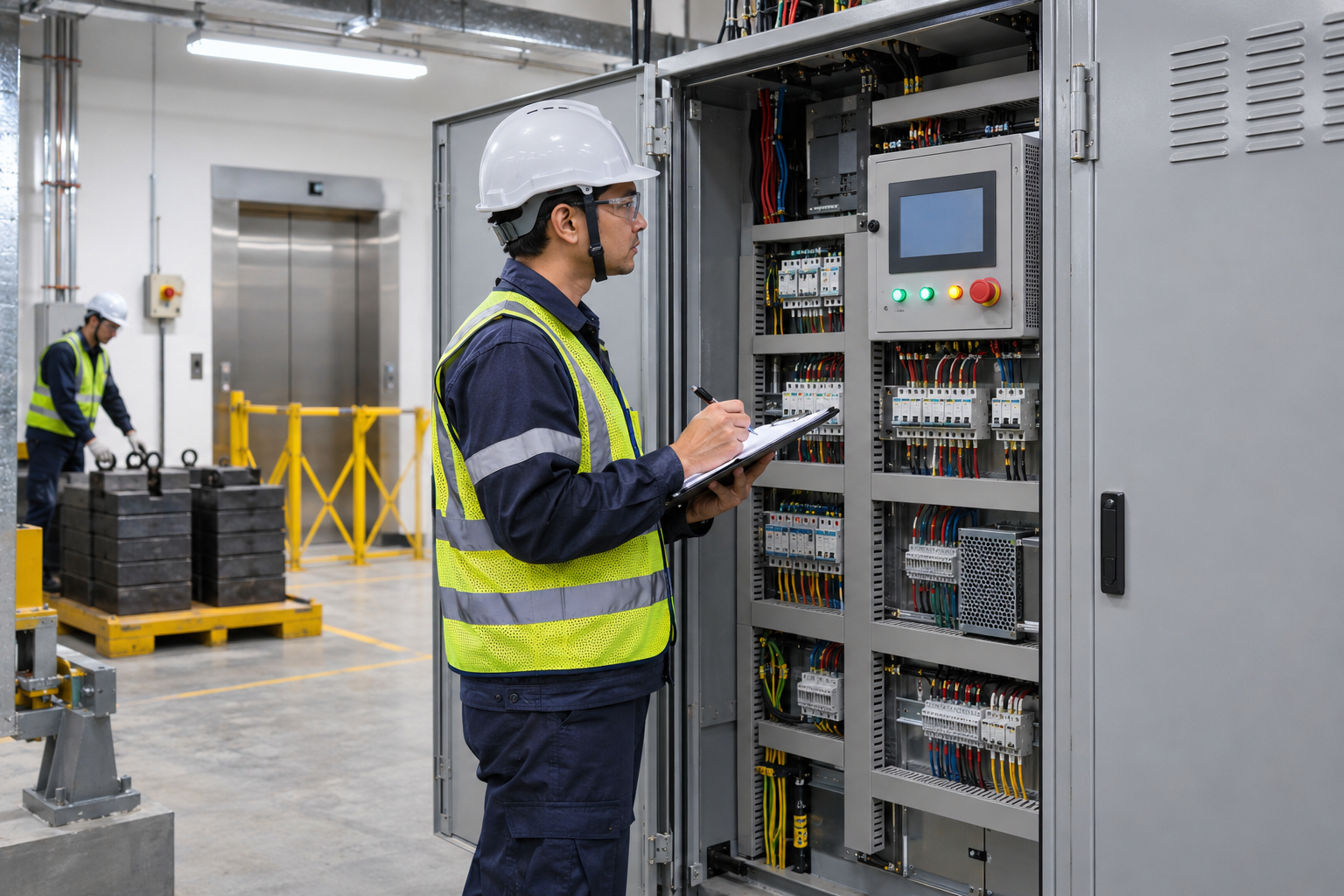
- Prepare the load and site: use verifiable test weights and distribute them as specified; establish barriers and assign a test lead, operator, observers and emergency roles.
- Keep test items separate: distinguish run, traction, grouped-brake, 125% brake and overload-protection checks rather than treating one as a replacement for another.
- Keep complete records: retain load evidence, test conditions, measurements, required video records, abnormalities and corrective actions.
- Inspect after testing: examine the brake, traction components, suspension, car and related structures for abnormal conditions; complete required functional checks before return to service.
If the test produces abnormal stopping, unusual noise, slip, excessive vibration or visible deformation, stop the procedure under the emergency plan and have qualified personnel assess the equipment. High-stress test conditions should not be repeated simply to obtain a desired result.
Conclusion: load testing is a targeted, bounded safety verification
A 100% rated-load condition helps evaluate operation at rated capacity and, in the prescribed test, verifies brake redundancy. A 125% test provides evidence of braking or traction capability under a higher specified load. The value of an elevator load test is not in using the largest load or testing more often, but in selecting the correct item, following the applicable procedure, using competent personnel, preserving reliable records and closing out any abnormal finding.
KERUI can help customers organize elevator documentation, test preparation and maintenance-service requirements. Confirm specific tests, intervals and acceptance criteria against current rules, the inspection body’s requirements, manufacturer instructions and a site-specific professional assessment.
References
- SAMR: TSG T7001—2023, Elevator Supervision Inspection and Periodic Inspection Rules, including rated-load grouped-brake testing, traction-capability tests, the 125% rated-load brake test and its interval.
- SAMR: Implementation notice for the updated elevator inspection and testing rules, clarifying the six-year interval based on the year of the most recent 125% rated-load brake test.
This article is general technical information, not a work instruction for a specific elevator. Requirements differ by equipment and jurisdiction; tests must be planned and performed by qualified organizations in accordance with current rules, manufacturer documentation and a site-specific risk assessment.