
Elevator Installation in East Africa: Survey the Shaft, Plan the Work, Control the Details
For an elevator installation in East Africa, delivery to the construction site is only the beginning of the field work. The completed shaft may differ from the drawings, power interruptions may affect the schedule, and the exact tools or spare parts needed may not be readily available nearby. Progress depends on an early site survey, careful material planning and clear checks at each installation stage.
KERUI has hands-on experience on elevator projects in Africa. Depending on the project scope, our support can cover shaft review, configuration coordination, civil-work correction recommendations, China procurement and export coordination, overseas elevator installation support, commissioning guidance, local-team training and follow-up maintenance or remote technical assistance. The exact scope is confirmed against the project documents, contract and site conditions.
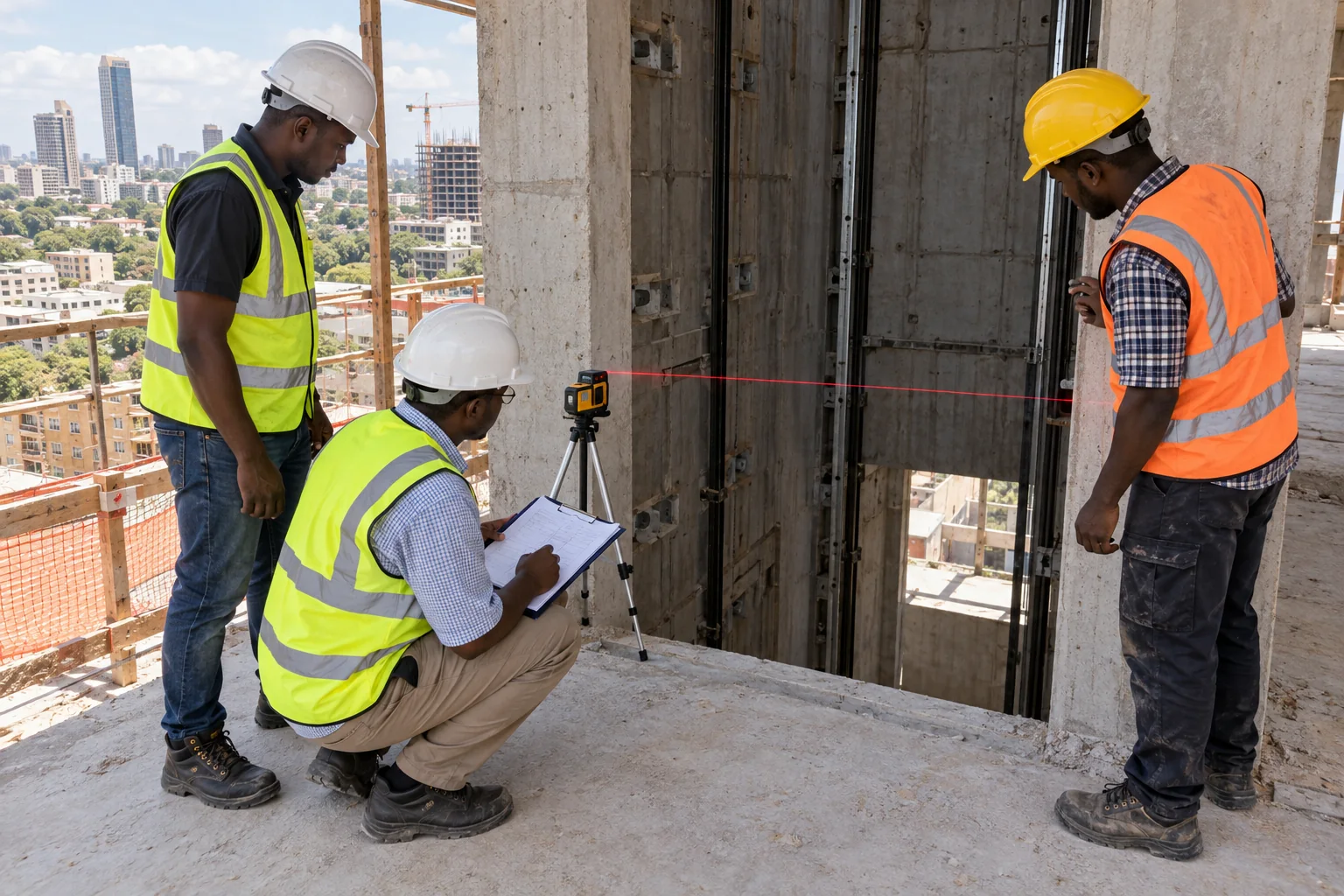
1. Survey every lift shaft before installation
Do not rely only on early architectural or tender drawings. Actual construction may differ. Before installation, measure each lift at every landing and record the shaft width and depth, vertical deviation, entrance centre lines, finished-floor levels, pit depth, headroom and fixing conditions for rails and equipment.
| Area | What to record | Coordination required |
|---|---|---|
| Shaft | Clear dimensions at each floor, vertical deviation and local projections | Compare with the approved layout and check car, rail and safety clearances |
| Landing openings | Centre lines, width, height, finished surfaces and floor levels | Resolve civil corrections before installing entrances |
| Pit and headroom | Actual dimensions, obstructions and access conditions | Confirm buffers, limits and overhead safety requirements |
| Fixing structure | Walls, beams, inserts, bracket locations and support conditions | Obtain structural review when the fixing arrangement needs change |
Prepare a written survey and action list showing the location, measured deviation, design reference, recommendation and responsible party. Any change affecting the structure or lift safety spaces must be reviewed and approved by the appropriate project professionals. Do not cut structural elements or change the lift arrangement simply to recover time.
2. Plan for power interruptions
Some projects experience temporary outages, unstable supply or generator changeovers. Before mobilisation, confirm temporary power, lighting, tool supply, charging arrangements and the site contact. Include outage notification, work-area checks and restart approval in the daily plan.
After a power interruption, verify the equipment state and isolate it according to the site safety procedure. When power returns, check the supply and equipment before resuming. Shaft, car-top, pit and work-at-height activities also require suitable fall protection, barriers and communication. Build time allowance into the schedule and divide work into inspectable stages so an outage does not lead to skipped checks.
3. Check tools and parts against the work sequence
Specialist elevator tools, correctly specified parts and some consumables may not be easy to source close to the project. A missing tool can force measurement work to be repeated; a missing fastener or terminal can block the next installation step. Prepare a detailed list from the lift model, method statement and expected work.
- Tools: measuring and alignment equipment, specialist installation tools, inspected power tools and PPE.
- Installation materials: specified fasteners, terminals, cable accessories, labels and common consumables.
- Spares: technically verified, model-compatible wear parts and commissioning components.
- Documents: approved drawings, wiring diagrams, installation instructions, packing list, parameters and fault guidance.
Pack by lift number and work sequence. Record quantities, specifications, use and work stage, and keep loading photographs. Safety components and electrical parts must match their ratings, environment and manufacturer requirements. Similar appearance alone is not proof of compatibility.
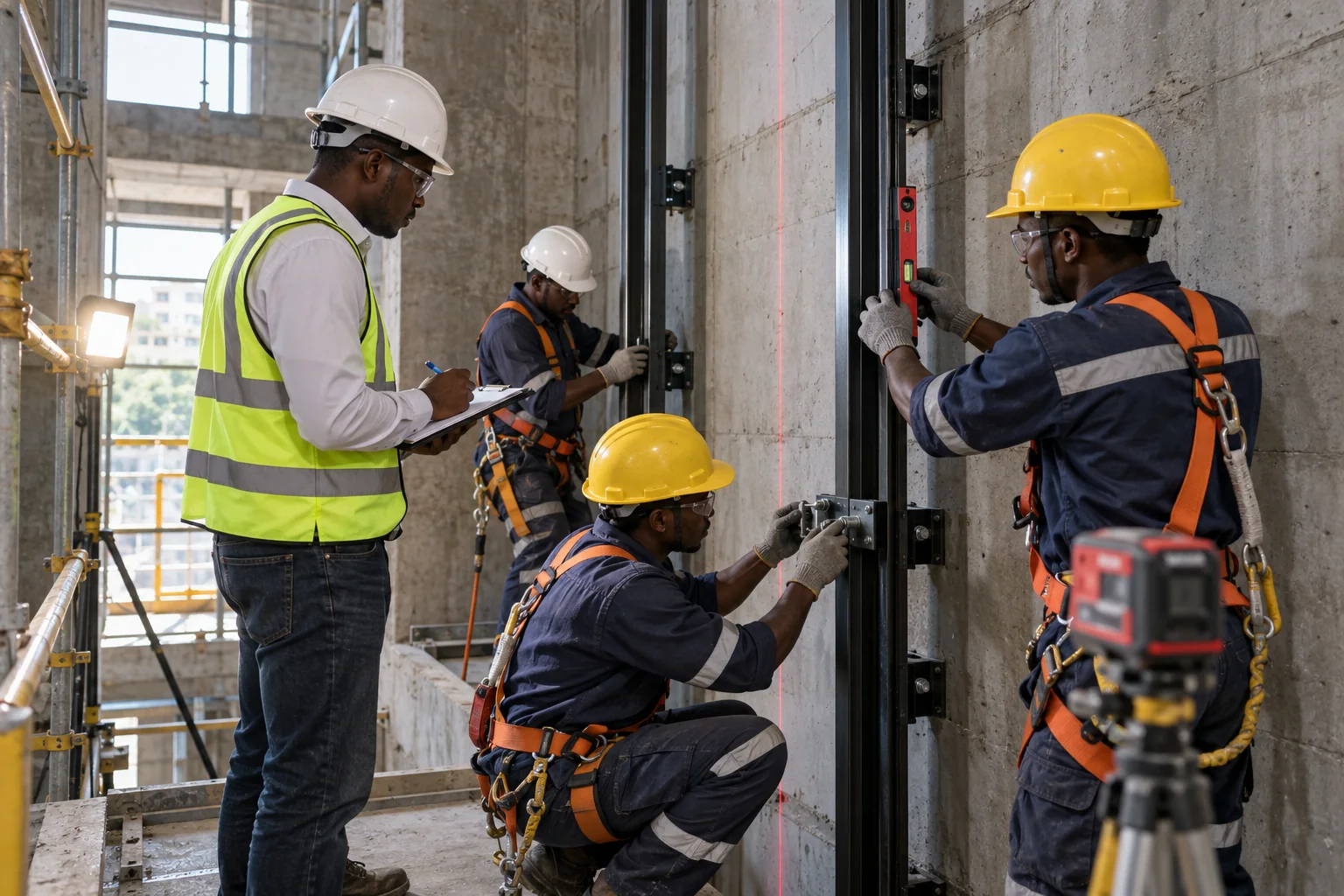
4. Give step-by-step briefings and inspect the work
Installation teams differ in experience and familiarity with a particular system. A site supervisor should explain the task, drawing, tools, safety requirements and acceptance criteria, then confirm that the team understands before work starts. “Install the guide rails” should include the datum, positioning sequence, tools, records, inspection points and the stop-and-report process for deviations.
A useful training method is to demonstrate the task, complete one example together, then let the team perform the next one while a supervisor checks it. Use a short daily briefing to confirm tasks, prerequisites, materials, power arrangements and safety measures. Assign a responsible person to inspect rails, entrances, wiring and safety circuits, and keep records. The ILO construction training package also highlights training, work organisation and supervision as important parts of safe construction work. [ILO training package](https://www.ilo.org/resource/training-material/ilo-training-package-code-practice-safety-and-health-construction)
5. Set quality hold points to limit rework
Based on the manufacturer's instructions, approved drawings and local acceptance requirements, set inspection points for the shaft survey, rail brackets and alignment, landing doors and locks, wiring, safety circuits, machine and brake setup, levelling and operational tests, as-built documents and team training.
For each nonconformity, record its location, measurement, corrective action, owner and recheck result. Do not treat an open issue as accepted, and do not let the next stage cover it up. Follow applicable local regulations and approved design requirements. ISO 8100-1:2026 is an important safety reference for lifts within its scope, while each project must also confirm the local rules and approvals that apply. [ISO 8100-1:2026](https://www.iso.org/cms/%20render/live/en/sites/isoorg/contents/data/standard/08/05/80553.html)
6. KERUI's field experience on African projects
KERUI has hands-on experience on elevator projects in Africa. According to the project stage, we can support shaft review and measurement, civil-work correction recommendations, elevator configuration and procurement coordination, installation guidance, commissioning, local-team training, maintenance planning and remote technical assistance. We turn site issues into survey records, correction lists, installation steps and traceable inspections so owners, contractors and installers can work from the same technical information.
See KERUI's Ethiopia commercial complex elevator project case for an example of our African project experience. Each project has different building conditions, supply scope and service responsibilities; the case should be read within its specific project context.
Conclusion: turn site uncertainty into an actionable plan
Successful elevator installation in Africa starts with verifying the shaft, allowing for power interruptions, checking tools and parts down to the required specification, and using clear briefings and inspections to keep work controlled. Installation is a delivery process that connects the site survey, civil interfaces, installation, commissioning and long-term service.
For elevator export to Africa and East Africa elevator installation, confirm shaft review, installation responsibilities, technical supervision, commissioning, acceptance documents, spares and maintenance during procurement. KERUI can support the coordination between elevator configuration and site conditions according to each project scope.