
Elevator Procurement in East Africa: Power Protection, Rescue Supply and Spare Parts
Elevator procurement in East Africa should not be reduced to capacity, speed, finishes and equipment price. For projects in Ethiopia, Kenya and neighbouring markets, buyers also need to examine site power quality, outage patterns, backup generation, installation capability, spare-parts lead time and long-term maintenance.
World Bank enterprise surveys track outages, outage losses and generator ownership, while the International Energy Agency continues to identify reliable electricity access as a material challenge in Sub-Saharan Africa. These regional sources do not replace a project power survey. They do explain why an elevator export to Africa needs a site-specific power and service strategy before manufacturing begins.
1. Specify voltage protection from measured site data
Controllers, variable-frequency drives, brakes, door operators and safety circuits all operate within manufacturer-defined limits for voltage, phase sequence, phase loss, frequency, harmonics and earthing. Supply outside those limits can trigger protective trips, intermittent faults, door problems and premature stress on electronic components.
Before specifying an elevator voltage stabilizer, record incoming voltage and frequency at different times, phase imbalance, outage duration and the output of any standby generator. Size the solution around the drive topology, operating and regenerative conditions, number of lifts, maintenance bypass and actual input range—not simply a multiple of motor nameplate power.
| Equipment | Purpose | Project checks |
|---|---|---|
| Three-phase automatic voltage regulator | Correct sustained high or low voltage within its designed input range | Input window, rating, response, bypass, cooling and VFD compatibility |
| Phase and voltage relay | Detect phase loss, reversal and severe over/undervoltage | Thresholds, delay and interface with the elevator control system |
| Surge protective device | Reduce transient risk from switching or induced lightning surges | Local lightning design, earthing, coordinated protection and replacement indication |
| Generator compatibility study | Confirm the lift can start and remain stable on emergency generation | Generator rating, frequency control, harmonics, earthing and load sequence |
A stabilizer cannot bridge a blackout or correct inadequate generator capacity, poor earthing, uncontrolled frequency or severe harmonics. Final protection must follow measured conditions, local electrical rules and the lift manufacturer's requirements.
2. Separate automatic rescue from continued operation
The phrase elevator backup power often combines two very different requirements:
- Automatic rescue device (ARD): after mains failure, the car travels in a controlled manner to an appropriate landing and releases passengers. It is a rescue function, not prolonged normal service.
- Building emergency supply: hospitals, hotels, tall buildings and critical facilities may need selected lifts to continue operating. This requires an engineered generator, central UPS or other emergency source, with defined priorities and duty.
The specification should define rescue direction, allowable load, response time, door sequence, battery life and periodic testing. Generator-backed operation also requires review of transfer switching, neutral and earthing, frequency recovery, starting sequence and the number of lifts permitted to run. Commission the complete system under realistic loss-of-power conditions.
3. Build a risk-based spare-parts package
Parts sent from China may require model confirmation, purchasing, international transport and customs clearance. A practical elevator spare-parts plan for Africa reduces the chance that a small component causes months of downtime. There is no universal spare percentage: stock should reflect fleet size, model standardisation, usage, local supply and technician capability.
| Stock level | Typical planning items | Control point |
|---|---|---|
| Installation allowance | Fasteners, terminals, fuses, cable accessories and consumables | Match box numbers to lift and installation sequence |
| Routine maintenance stock | Door shoes, rollers or belts, buttons, relays, contactors, sensors, fans and rescue batteries | Record specification, applicable lift, shelf life and minimum stock |
| Critical downtime stock | Selected encoder, door controller, drive or control modules based on risk | Verify firmware, parameter backup, compatibility and dry antistatic storage |
| Documentation and tools | Wiring diagrams, backups, commissioning records, special tools and fault-code guidance | Provide a usable language version and train the local maintenance team |
Safety components and electronic modules must be genuine or approved, compatible and traceable. Spare stock supports preventive maintenance; it does not replace it.
4. Container planning affects installation productivity
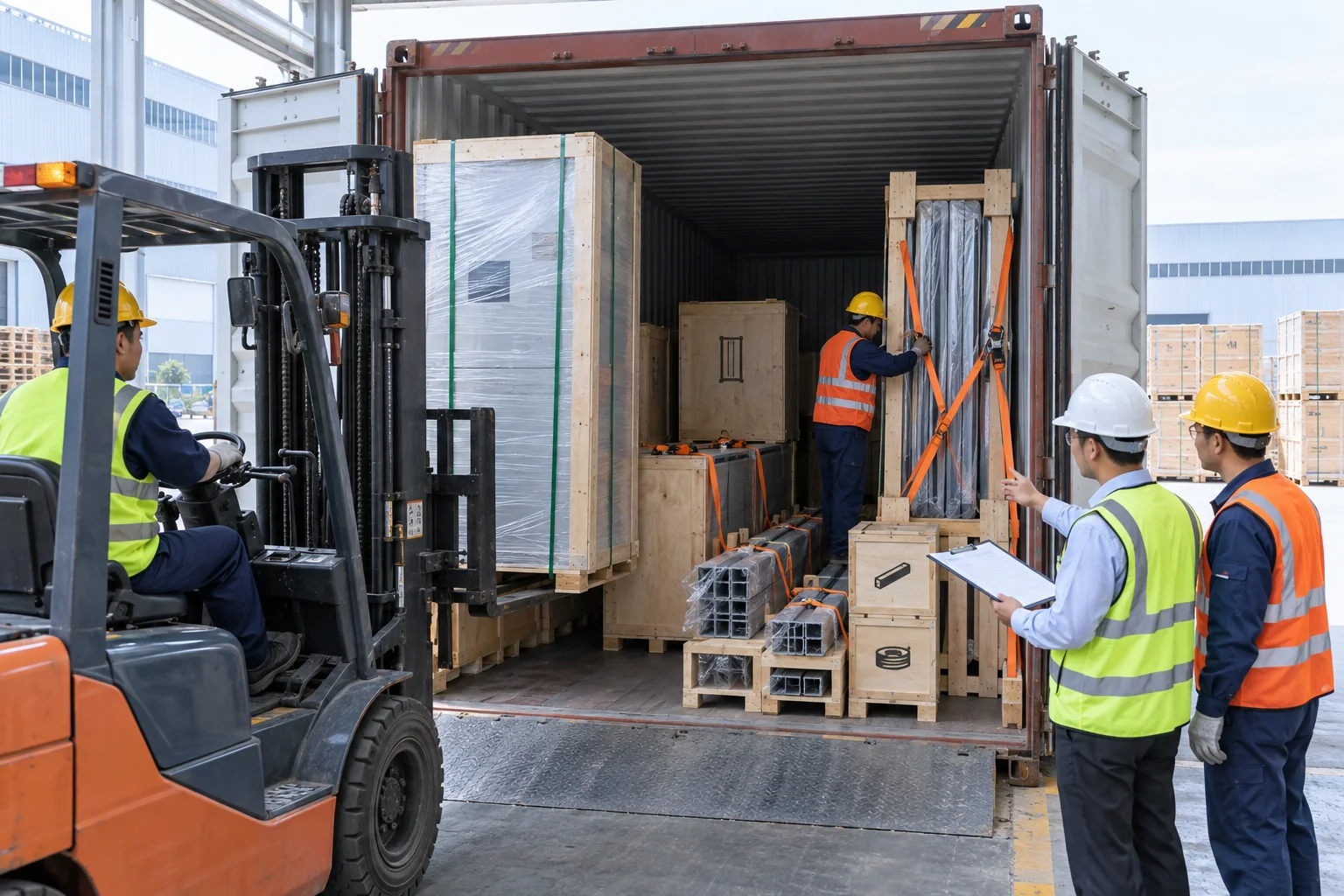
For a China elevator supplier serving East Africa, packing lists should do more than satisfy customs. Protect controllers and electronic parts from moisture and impact. Secure rails, entrances and car components for weight distribution, unloading equipment and erection sequence. Label project spares separately from installation consumables.
Box references can identify the building, lift number and work stage. Loading photographs and a structured packing register help the receiving team unload, inspect and store equipment without unnecessary handling or lost parts.
5. Five information groups for an East Africa elevator enquiry
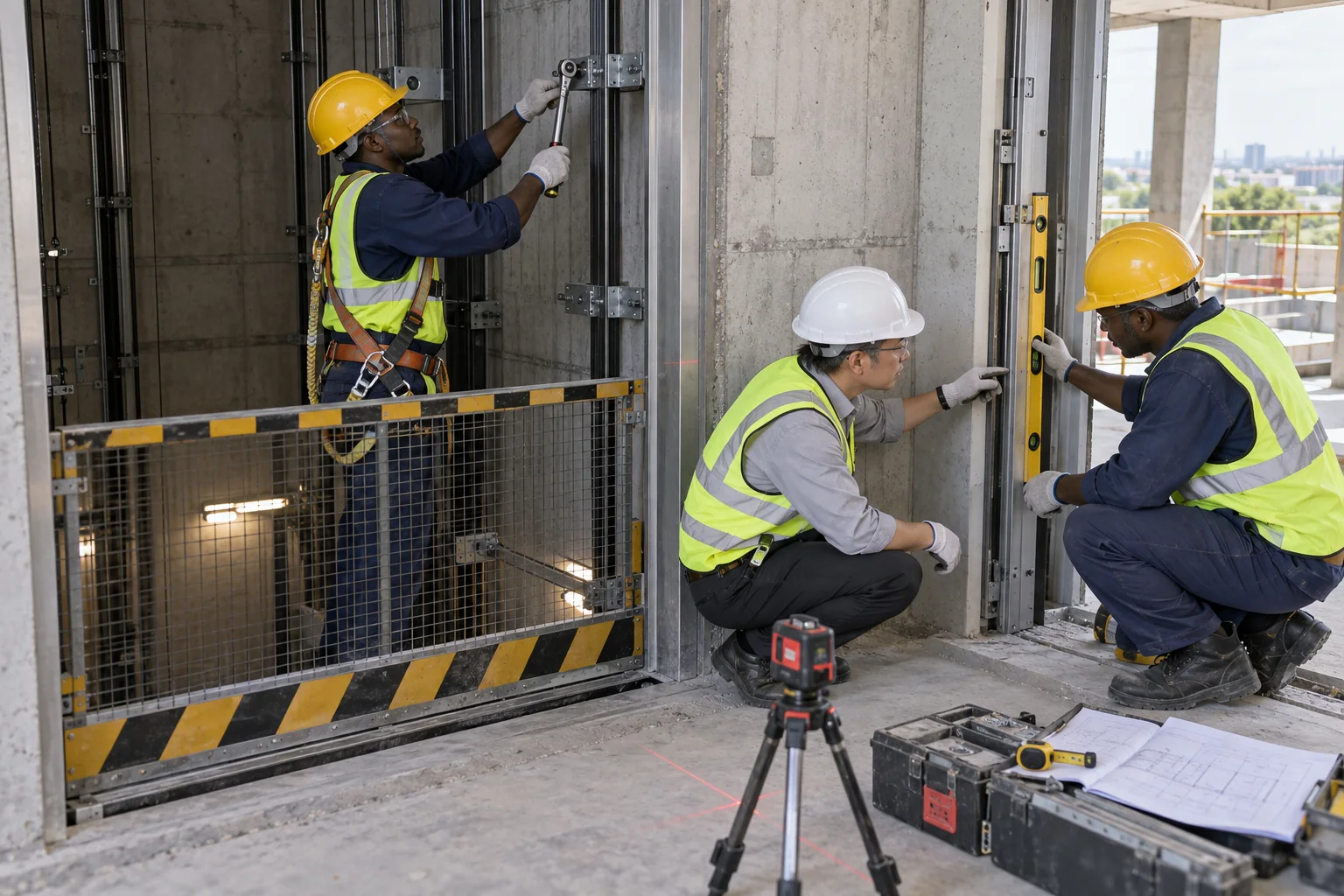
- Building: country, city, use, measured shaft, pit, headroom, openings and structure.
- Power: nominal voltage, frequency, earthing, measured variation, outage pattern and generator or solar-storage information.
- Duty: quantity, load, speed, stops, traffic, accessibility, fire and emergency requirements.
- Delivery: local installer capability, acceptance rules, programme, unloading and storage.
- Lifecycle service: maintenance provider, response target, local stock, remote connectivity and training language.
6. How KERUI supports elevator projects in East Africa
KERUI can support owners and contractors with elevator selection, China procurement, power-condition review, voltage protection, ARD planning, project spare packages, packing and export coordination, elevator installation support, commissioning training and remote technical service.
The objective is not to apply a generic “Africa package.” It is to connect the building, measured power, equipment, installation team and maintenance plan so the lift can be installed, accepted and kept in service. Final specifications remain subject to destination-country rules, the approved design and manufacturer instructions.
Sources and scope
The regional context refers to the World Bank's enterprise-survey framework for outages, losses and generator ownership, and the IEA's public analysis of reliable power in Sub-Saharan Africa. These sources support project-level due diligence; they do not establish one electrical specification for every East African site.