
Marine Elevator Wire Rope Inspection: Wear, Broken Wires and Replacement
Marine elevators operate amid vibration, moisture, salt-laden air and changing temperatures. Suspension ropes carry the car and counterweight, so their condition affects traction, ride quality and safety. A proper marine elevator inspection goes beyond a quick visual check: it considers diameter reduction, the number and distribution of broken wires, strand integrity, corrosion, rope tension and the condition of sheaves and grooves.
1. Confirm the rope specification before inspection
Before a ship elevator wire rope inspection, identify the elevator and rope set: nominal rope diameter, construction (including strand and wire arrangement), core type, grade, manufacturer, installation or replacement date, rope certificate and the maker's inspection/discard instructions. Without that baseline, a caliper reading or visual impression can be misinterpreted across different rope constructions, load conditions and measurement locations.
Inspection should be carried out by trained technicians under the vessel's safety management procedures. Confirm the elevator status, isolation and protection against unintended movement, communications, lighting, vessel motion and work permits. Then inspect accessible rope sections using the prescribed inspection mode. Pay particular attention near traction and deflector sheaves, groove-contact zones, terminations, repeated bending areas and locations associated with slip, unusual noise or uneven tension.
2. Key point 1: measure diameter reduction; do not rely on appearance
Marine elevator rope diameter can decrease through crown-wire wear, internal abrasion, loss of core support or corrosion. Record the manufacturer's nominal diameter, then use a suitable, calibrated measuring tool at suspected worst-wear locations and follow the maker's prescribed method. Compare the affected section with adjacent rope and record measurement direction and location. A common calculation is: (nominal diameter − measured diameter) ÷ nominal diameter × 100%.
Some local lift-rope replacement guidance uses a 10% diameter reduction as one replacement criterion. However, limits vary by rope construction, elevator design and regulatory system; manufacturer guidance can be more stringent—for example, some technical material calls for discard at a 6% reduction. Therefore, “more than 10% of the original diameter” should not be presented as a universal marine-elevator safety limit. Apply the relevant vessel documentation, flag/class requirements and maker criteria, using the stricter applicable threshold. Other serious defects may require action before any diameter threshold is reached. The Hong Kong Electrical and Mechanical Services Department's suspension-rope amendment is one jurisdiction-specific example and expressly compares its criteria with any stricter manufacturer discard criteria.
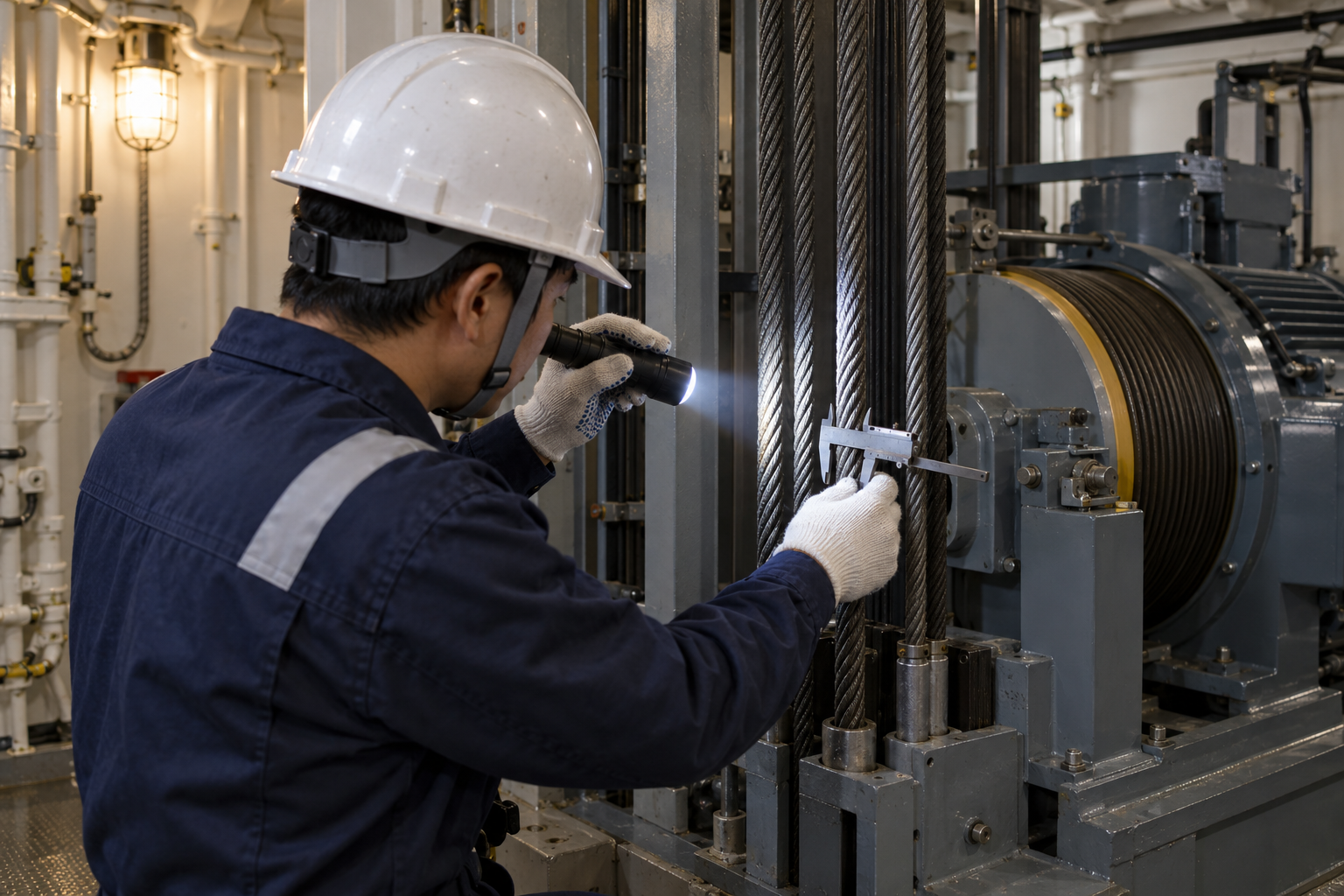
3. Key point 2: inspect broken wires, broken strands and structural damage
When broken wires are found, record more than “present” or “not present.” A competent inspector should count them, note their location, whether they are concentrated in one strand, adjacent to one another, located in valleys between strands, and how they are distributed over the prescribed reference length or rope lay. Allowable counts differ between rope constructions. Wire breaks concentrated in one or two strands, adjacent breaks, valley breaks or a broken strand are generally more concerning than a small number of evenly distributed surface breaks.
Also look for loose or opened strands, bird-caging, kinks, crushing, local necking, protruding core, severe rust or pitting, unusual red wear debris, uneven lubrication, and loose or corroded end terminations. A broken strand, significant structural distortion or severe corrosion should be treated as a serious defect: isolate the elevator and arrange marine elevator repair assessment rather than waiting for the next routine maintenance visit.

4. Why does condemnation of one suspension rope usually mean replacing the set?
Multiple suspension ropes operate as a matched set. If one rope reaches its discard condition because of wear, broken wires, corrosion or structural damage, the remaining ropes have often experienced similar service time and environment. Their condition may differ, but differences in diameter, elongation, stiffness, tension or friction can lead to uneven load sharing and increase stress on the remaining ropes and traction system.
Accordingly, if one rope in the same suspension set is condemned, the normal approach is to replace the complete matched set in accordance with the maker and applicable rules—not just the single visibly damaged rope. Replacement ropes must meet the original design or an approved equivalent, followed by tension equalisation, termination checks and inspection of sheaves/grooves and post-replacement testing. Confirm the exact scope of “the set” from the elevator's design and governing requirements. Governor ropes and compensating ropes are separate functional systems and should be assessed under their own criteria. Some rules permit a narrow exception for a single rope damaged during installation or acceptance testing before entering service; that exception should not be assumed for ropes worn in normal operation.
| Finding | Assessment focus | Typical action |
|---|---|---|
| Significant diameter loss | Compare nominal diameter with maker limits and applicable rules | Take out of service and replace the matched set when a discard threshold is met |
| Broken wires | Count, rope lay, concentration, adjacency and valley location | Apply construction-specific criteria; isolate if concentrated or at discard limit |
| Broken/open strands or severe distortion | Continuity of load-bearing structure and core/strand displacement | Treat as a serious defect; isolate and obtain competent replacement assessment |
| Corrosion, red debris or lubrication anomaly | Pitting, internal-wear clues, sheave grooves and root cause | Assess together with diameter and wire breaks; do not mask with lubricant |
5. Inspection records and checks after replacement
A traceable marine elevator inspection record should identify the vessel and elevator (redacted where appropriate), rope designation and nominal diameter, inspection date and operating condition, measuring instrument, measurement locations and readings, broken-wire counts and distribution, corrosion/deformation photographs, the maker or applicable discard criteria, conclusion, out-of-service/replacement advice and responsible personnel. If repair is planned, also check traction and deflector sheave grooves, uneven wear, terminations, rope-tension differences, lubrication and alignment issues that may have caused premature damage.
After replacement, verify the rope-set specification, tension balance, end attachments, running noise and vibration, landing accuracy and relevant safety functions in accordance with the equipment documents and work plan. Load or functional tests may be required by the flag administration, classification society or manufacturer. Keep the records. A completed inspection does not eliminate future maintenance: continue planned marine elevator maintenance and log operational changes and effects of the marine environment.
Conclusion: assess the set and follow the applicable criteria
The two core tasks in marine elevator wire rope inspection are measuring diameter reduction and assessing broken wires, broken strands and other structural damage. A rope that reaches the applicable diameter limit, meets its construction-specific wire-break criteria, or shows a broken strand or severe corrosion requires prompt competent assessment. If one suspension rope is condemned, the matched rope set will normally need replacement and the traction system should be checked. This connects rope inspection, marine elevator repair and ongoing maintenance into one safety process rather than treating only the visible symptom.
References: Hong Kong EMSD: amendment on suspension-rope replacement criteria; PFEIFER DRAKO: elevator rope product and discard-criteria guidance. These illustrate that thresholds differ and do not replace the requirements governing a particular vessel.