
Simplex, Duplex and Group Control: How Elevator Dispatch Systems Differ
In building elevator selection, the number of cars is only one question. The control arrangement determines who receives a hall call, which car answers it, and whether several elevators coordinate as one system.
This article uses common project terminology to explain simplex elevator control, duplex elevator control and elevator group control. Feature names, applicable car counts and algorithms vary by manufacturer. The final choice should follow traffic analysis, product documents and local requirements.
First, separate motion control from dispatch control
Each car has its own operating control for doors, levelling, speed, safety circuits and car calls. Simplex, duplex and group control in this guide mainly describe the relationship between hall calls and car dispatch. They do not mean that several cars share one safety circuit.
| Arrangement | Hall-call handling | Main purpose | Typical project form |
|---|---|---|---|
| Simplex | One car receives and completes calls independently | Clear independent service for a single car | Low-traffic residential, small offices, dedicated goods lifts |
| Duplex | Usually two cars share hall calls and the system assigns a suitable car | Coordinate two cars and reduce duplicated travel | Two-car residential, small hotel or office projects |
| Group control | A dispatcher evaluates several cars and allocates hall or destination demand | Balance waiting, journey time, capacity and operating strategies | Elevator banks in larger offices, hotels, hospitals and mixed-use buildings |
1. What is simplex elevator control?
Simplex control means one elevator operates as an independent system. A passenger registers an up or down hall call; that car responds. The passenger then selects a destination inside the car. If another elevator exists in the same building but the cars have no common dispatch relationship, both may still operate independently.
What does simplex control do?
- Completes hall calls, car calls and service with one independent elevator.
- Provides a straightforward arrangement for a defined, modest traffic demand.
- Allows a car to serve a separate function or access policy, such as certain service or freight elevators.
Where is simplex suitable?
It may suit a low-rise or low-traffic building where one car meets the assessed demand: a small residential building, small office, dedicated service lift or factory goods lift. Building size alone is not enough. Consider population, peak traffic, accessibility, material handling and what happens during maintenance.
Limitation: no second car participates in hall-call allocation. Waiting can grow when the car is distant, full or making several stops, and a shutdown removes that independent service unless another route is available.
2. What is duplex elevator control?
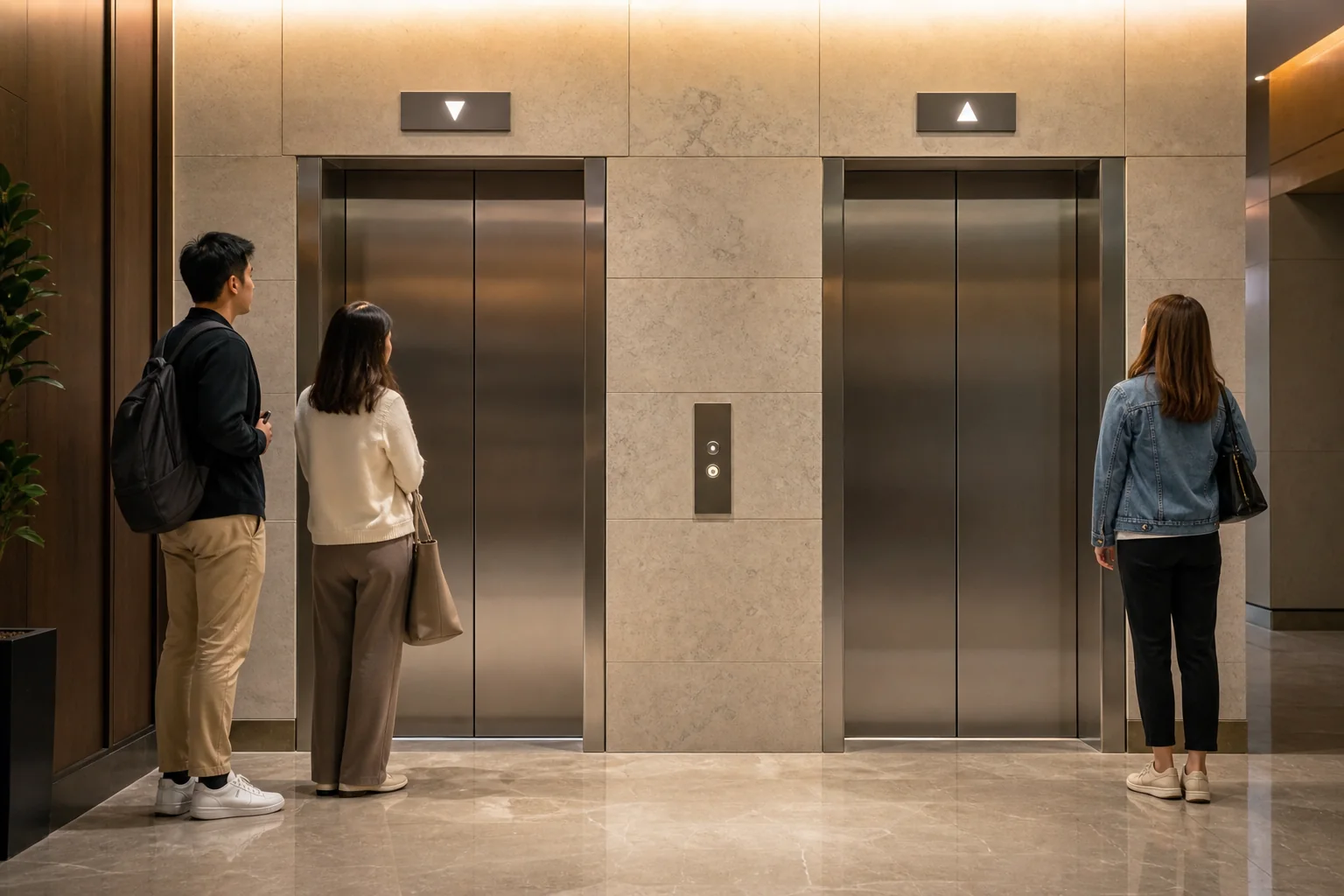
Duplex control commonly means that two elevators share hall-call dispatch. A passenger normally registers one up or down call. The system evaluates conditions such as each car’s position, direction, committed stops and service availability, then assigns a suitable car. Destination selection still takes place inside the chosen car.
Duplex does not mean both cars answer every call, and it is more than wiring two buttons together. Compatible communication and dispatch logic are required; the exact decision criteria depend on the manufacturer.
What does duplex control do?
- Prevents uncoordinated duplicate responses to one hall demand.
- Uses the other car’s location and direction to reduce unnecessary empty travel and reversal.
- Distributes short peak demand more effectively between two cars.
- May allow the other car to serve available calls when one is out of normal service, subject to the system design; this is not a guarantee of full redundancy.
Where is duplex suitable?
It is commonly evaluated where two adjacent passenger elevators serve broadly similar floors and traffic requires coordination without a complex multi-car strategy—for example, residential buildings, boutique hotels and smaller offices. If load, speed, served floors or car purpose differ, compatibility and call allocation need specific review.
3. What is elevator group control?
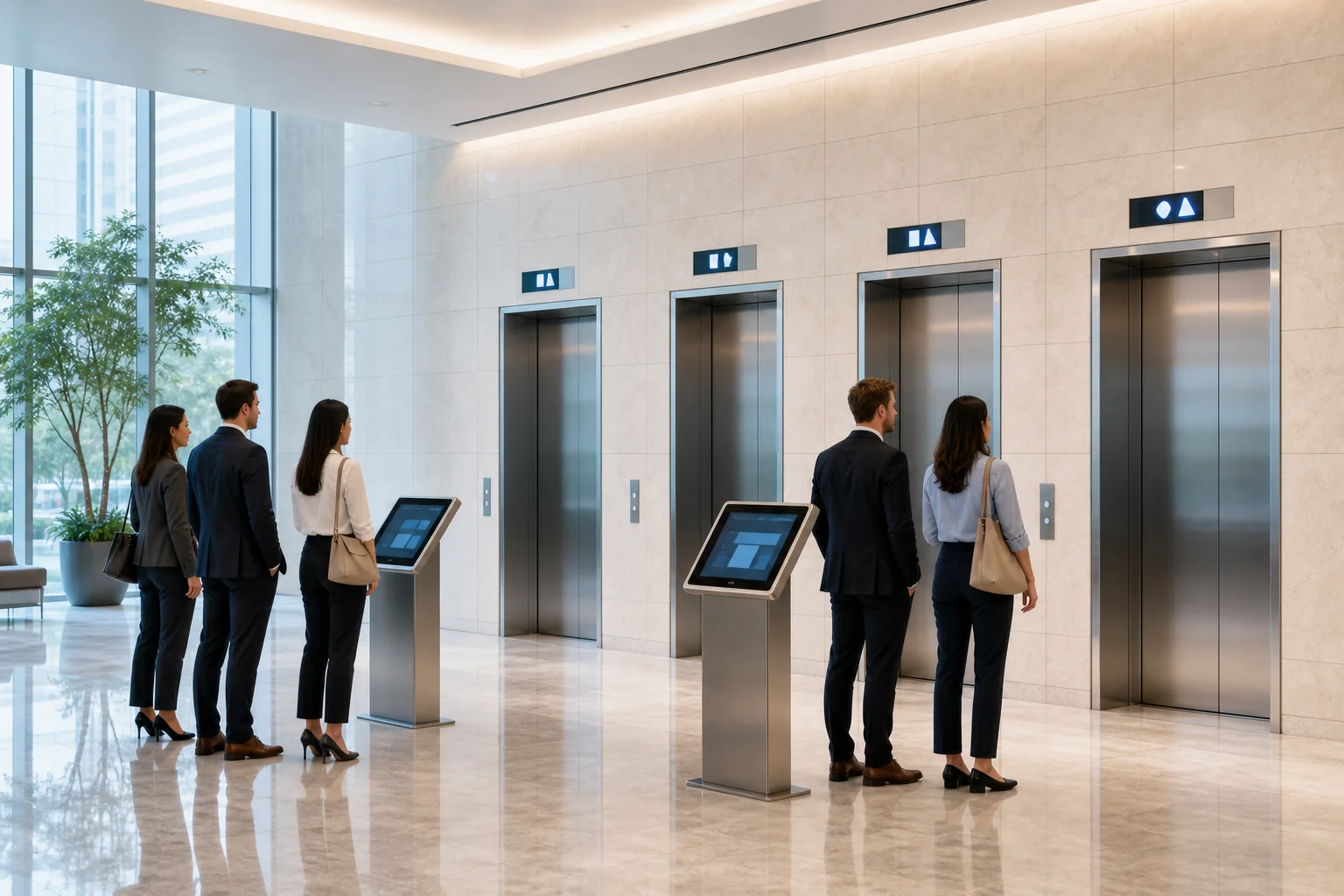
Elevator group control dispatches an elevator bank as a whole. Instead of simply selecting the nearest car, a group controller may consider car position, direction, load, existing car calls, hall demand, expected stops, peak patterns and service zones to choose a car for current and anticipated demand.
The defining idea is not merely “controlling many elevators”; it is allocating work for the performance of the entire group. Hitachi describes coordinated allocation with waiting time in view. Mitsubishi materials describe cooperative assignment, peak strategies and energy-aware allocation. Actual functions and results depend on the building and selected system, so brochure performance figures should not be treated as a project guarantee.
What problems does group control address?
- Long waits: reduce the chance that cars cluster in one area while other floors lack service.
- Handling capacity: adapt strategies for morning up-peak, inter-floor traffic and evening down-peak.
- Repeated stops: use known calls and traffic direction to reduce avoidable stopping.
- Operation and energy: some products can adjust car allocation in light traffic, but no fixed saving should be assumed.
- Special service: where supported, manage main floors, zoning, priority, independent or emergency modes with defined transitions and permissions.
Where is group control suitable?
It is normally a key consideration for a bank of three or more elevators serving similar floors in medium or high-traffic buildings: offices, large hotels, hospitals, mixed-use developments and transport facilities. Two cars can also use more advanced dispatch functions, so terminology should not be decided by car count alone. Elevator traffic analysis should confirm car quantity, zoning, load, speed and control strategy.
Are group control and destination control the same?
Not exactly. With conventional group control, a passenger registers up or down at the hall, then selects a floor inside the car. The dispatcher knows the direction but may not know each passenger’s exact destination when assigning the car.
Destination control asks for the destination in the lobby and directs the passenger to an assigned elevator. This can group passengers travelling to similar floors. KONE explains that destination systems consider desired floors and waiting-passenger numbers to reduce unnecessary stops and improve people flow. Destination dispatch generally uses group-control logic, but not every group-controlled bank has destination terminals.
How to choose: do not ask only which system is “more advanced”
There is no universally best arrangement outside its building context. For building elevator selection or elevator procurement from China, prepare:
- Building use, floors, travel height and the floors served by each car.
- Resident or staff population, visitors, and morning, lunch and evening traffic patterns.
- Car count and layout, rated load, speed and any mixed specifications.
- Access control, turnstile, visitor-management and destination-dispatch interfaces.
- Service, accessibility, fire, VIP and independent-operation requirements.
- Service targets during maintenance, local codes, overseas elevator installation and after-sales arrangements.
Do not choose duplex merely because it sounds more advanced for two cars. For a larger bank, group control cannot compensate for fundamentally insufficient capacity or poor zoning. Dispatch optimizes the equipment that exists; it does not replace sound traffic and architectural planning.
Frequently asked questions
Are two elevators in the same building automatically duplex?
No. If they have separate hall calls and answer independently, they may still be simplex. Check the control drawings, hall-button relationship and product configuration.
Can two existing elevators be converted to duplex by adding a cable?
Not necessarily. Controller and software compatibility, hall signals, served floors, safety functions, inspection requirements and maintenance responsibility all need review. A coordinated modernization may be required.
Does group control always save more energy than duplex?
No general claim is valid. Energy depends on traffic, dispatch strategy, drive efficiency and standby features. Group control primarily coordinates several cars; energy optimization is one possible product function.
In summary: simplex lets one elevator serve independently; duplex coordinates two elevators; group control dispatches an elevator bank as a system. Start with building traffic and service requirements, then select the control arrangement and interfaces.
References: Hitachi group control overview, Mitsubishi group control brochure, and KONE destination control overview. References explain concepts and do not imply dealership status or a project performance commitment.