
A Nansha attendance is not only an elevator job. It is a time-limited port operation controlled by the berth plan, terminal security, immigration clearance and material filing. Complete engineering triage first, then mobilise against the agent-confirmed berth, clearance and net working window.
01 / PORT & VESSEL PROFILE
Nansha terminal profiles, berth counts and vessel mix
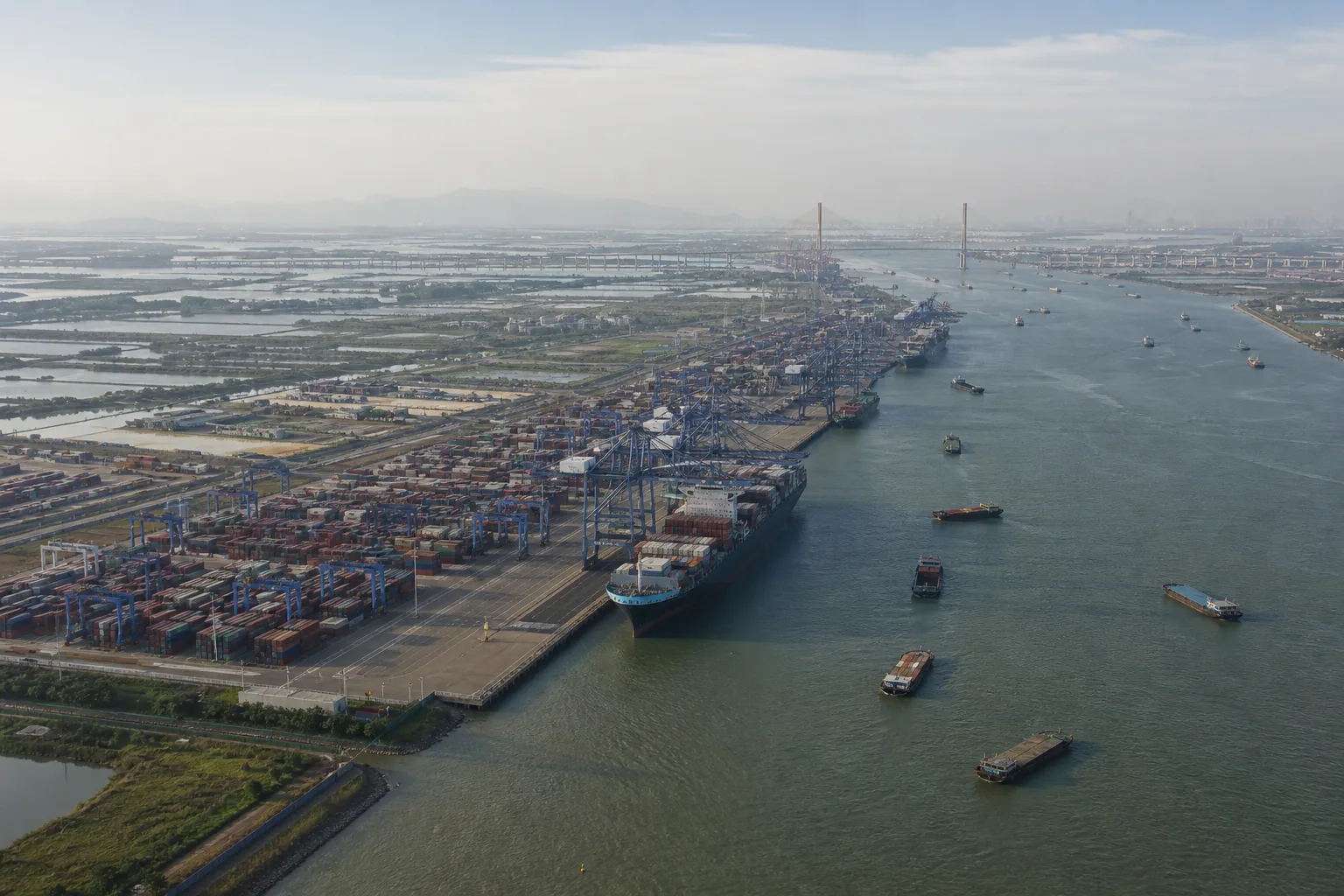
Nansha, around Longxue Island in the Pearl River Estuary, is Guangzhou Port's principal deep-water gateway. Official material identifies 20 large ocean-going container berths across Phases I–IV, alongside distinct automobile, grain/general, cruise and near-ocean facilities. The table keeps ocean berths, barge berths and specialist terminals in separate operating categories.
| Area / terminal | Berth count | Typical vessels | Attendance note |
|---|---|---|---|
| Nansha Container Terminal Phase I | Four ocean-going berths, numbered 1–4 | Domestic and international container services, including regional and mainline calls | Use the agent's confirmed terminal, berth and gate route; a port-wide schedule is not enough. |
| Nansha Container Terminal Phase II | Six ocean-going berths, numbered 5–10 | Large deep-sea container ships and international mainline vessels | This terminal has handled container ships above 24,000 TEU, so gangway and worksite transit time matter. |
| Nansha Container Terminal Phase III | Six ocean-going berths, numbered 11–16, plus barge facilities | Deep-sea container ships and river-sea feeder traffic | Attendance planning should allow for both ocean-vessel operations and barge-transfer constraints. |
| Nansha Phase IV automated terminal | Four ocean berths and 12 inland-barge berths | Container ships and Pearl River feeder barges | The official project description specifies two 100,000-ton-class and two 50,000-ton-class ocean berths. |
| Nansha automobile-port terminals | Eight roll-on/roll-off berths are publicly reported as open to foreign trade | Deep-sea and regional vehicle carriers | Confirm whether the call is at Nansha Auto, Haijia or the Near-Ocean terminal before filing access. |
| Grain/general terminal and cruise terminal | Published facilities include grain/general berths 1–6 and cruise berths 1–2 | Bulk grain or general cargo ships; cruise vessels | Security, boarding, tool and vehicle rules are terminal-specific and must not be copied from a container-terminal file. |
The service file needs the operator, exact terminal or phase, berth number, gangway position, vehicle gate and boarding window. Security and material rules can differ between terminals in the same port area.
02 / ETA · ETB · ETD
Turn vessel schedule data into a workable attendance window
| Code | Meaning | Required detail |
|---|---|---|
| ETA | Estimated Time of Arrival | Define whether ETA means anchorage or port limits. Use China Standard Time (UTC+8), 24-hour notation and a clear update timestamp. |
| ETB | Estimated Time of Berthing | Name the terminal, provisional berth, expected all-fast time and boarding window. Label an unconfirmed berth TBC. |
| ETD | Estimated Time of Departure | Work backwards from ETD to protect time for diagnosis, repair, proof testing, close-out, disembarkation and material exit. |
Vessel / IMO / Flag | Nansha terminal / phase | Berth: number or TBC | ETA / ETB / ETD: YYYY-MM-DD HH:mm CST | source and update time | agent contact | boarding window | net working hours.
03 / AGENT & BOARDING CLEARANCE
An agent-led clearance path for foreign-flag vessel attendance
Build the technical attendance file
Send vessel identity, flag, IMO number, schedule, local agent, elevator particulars, drawings, service history and structured fault evidence.
Complete remote engineering triage
Define likely failure modes, engineer count, working hours, test conditions, instruments, candidate spares and the commercial boundary.
Obtain the master's invitation
The letter should identify the vessel, port, purpose, dates, service company and engineers. It supports the case but does not grant access.
Freeze the agent's terminal checklist
Confirm immigration inspection, gate entry, vehicle routing, powered tools, batteries, spares, customs treatment, berth and boarding window.
File personnel and materials
Submit identity data, required boarding-permit information, relevant technical certificates, translations and insurance. Route controlled spares through the appointed broker.
Board and establish a safe system of work
The vessel provides a competent escort and implements isolation, lockout/tagout, safe access and shipboard induction.
Diagnose, repair or inspect, then prove
Record readings, defects, parts changed, functional and safety tests, limitations and any follow-up recommendation.
Close the port call
Reconcile tools and materials, complete exit formalities, and issue the agreed service record, inspection statement or report.
Informal references to a 'foreign-vessel pass' should never replace the formal permit name and current filing requirements. China's immigration authority states that personnel boarding a foreign vessel for repair must apply through the prescribed route, whether filed by the individual, employer, vessel representative or appointed entry-exit agent.
04 / TOOLS · SPARES · TECHNICIANS
Prepare tools, spares and people as three separate manifests
Tools and diagnostic instruments
List insulated tools, meters, diagnostic devices, laptops and PPE with make, model, quantity, serial number and battery status where requested.
Candidate spares
Use alarms, video, drawings and nameplates to identify exposure. Record part number, specification, quantity, value, origin and final disposition.
Customs and terminal filing
Send ship-bound spares to the agent or customs broker early. Do not assume they follow the same route as technicians' reusable hand tools.
Identity and boarding data
Prepare identity documents, photographs, the final personnel list, formal permit information and 24-hour contacts.
Competence evidence and translations
Submit relevant elevator or technical certificates and employer assignment documents, with accurate translations where required.
Insurance and safe-work pack
Carry valid insurance for every attendee plus risk assessment, method statement, PPE and lockout/tagout planning.
05 / URGENT REPAIR VS ANNUAL INSPECTION
Urgent repair and annual inspection are different missions
| Planning point | Urgent repair | Annual inspection |
|---|---|---|
| Opening information | Entrapment risk, operating status, alarms, first occurrence, repeatability and fault video. | Inspection basis, previous report, due date, elevator count and present condition. |
| Evidence priority | Electrical drawings, parameters, repair history, changed parts and fault evidence. | Complete drawings, operating manual, maintenance logs and earlier inspection records. |
| Spares strategy | Triage high-risk failures before travel and decide carry-on, local sourcing or a second call. | Lead with test instruments; prepare corrective parts only for known defects. |
| Vessel support | Assign a crew member who witnessed the failure and can arrange rapid isolation. | Assign at least one competent crew member for machine-space, shaft, car-top, pit and function tests. |
| Close-out | Cause assessment, work record, changed parts, proof tests and remaining risk. | Inspection scope, readings, findings, corrective actions and the agreed report. |
06 / SCHEDULE CHANGE PROTOCOL
Rebuild the service window whenever the port call moves
Communicate a known change 48 hours ahead where possible; if it occurs inside that period, update immediately. Reissue ETA, ETB, ETD, terminal, berth, agent and boarding window, then revalidate travel, permit validity, material manifests and net working hours.
07 / FAQ
Nansha marine elevator service FAQ
How many container berths are in the operating Nansha phases?+
Phases I–IV provide 20 large ocean-going container berths: 4, 6, 6 and 4 respectively. Phase IV also has 12 inland-barge berths; those are a separate operating category and should not be added to the ocean-berth total.
Does the master's invitation grant boarding access?+
No. It proves the business purpose. Repair personnel attending a foreign vessel remain subject to immigration inspection, terminal security and the permit route confirmed by the local agent.
May technicians carry tools and parts straight through the gate?+
Never assume so. Separate the tool, instrument, battery and ship-bound spare lists. Give the agent part numbers, quantities, values, origin and final disposition so the correct terminal and customs treatment can be confirmed.
What if the annual inspection finds a safety defect?+
Document the defect and decide whether the elevator should remain out of service. With owner approval, the scope may become repair, replacement and re-test; otherwise issue a clear limitation and follow-up plan.
How should a late schedule change be handled?+
Communicate known changes 48 hours ahead where possible. Inside that window, update ETA, ETB, ETD, berth, agent, boarding time and personnel list immediately, then reconfirm every permit and material filing.
OFFICIAL REFERENCES / 资料依据
Official sources and operating scope
- Guangzhou Port Authority: port-facility security certificate list and berth references
- Guangzhou Port Authority: completion and berth configuration of Nansha Phase IV
- Guangzhou Port Authority: foreign-trade berth count at Nansha automobile port
- Guangzhou Port Authority: ultra-large container vessel call at Nansha Phase II
- National Immigration Administration: permission to board foreign vessels for repair
This guide supports planning; it does not replace instructions from the terminal, immigration inspection, customs, class or flag administration. The local agent must reconfirm berth, schedule, clearance and filing requirements for every call.
RELATED SOUTH CHINA PORT GUIDE
Also calling Shenzhen Yantian? Use the Yantian service guide
The Yantian guide covers deep-water container terminal attendance, schedule reporting, agent filing and foreign-vessel boarding preparation.
Read the Yantian guide →