
A successful Yantian attendance controls two risks at once: the elevator fault and the berth window. Build the technical scope from evidence first, then mobilise against the agent-confirmed ETB, berth and boarding clearance. Treat every schedule change as an operational update, not an administrative detail.
01 / PORT & VESSEL PROFILE
Yantian terminals, berth facts and vessel profiles
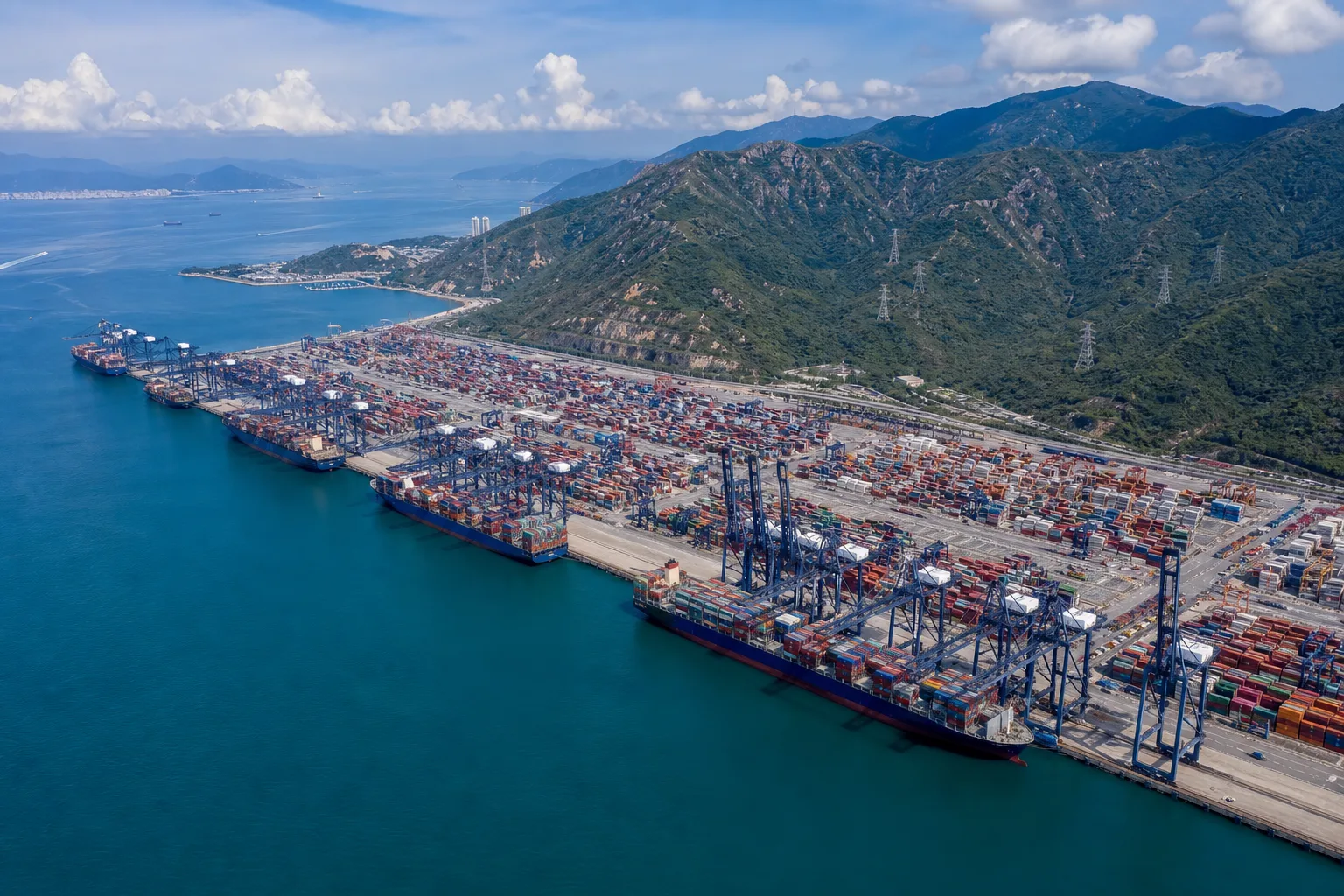
YANTIAN is Shenzhen's eastern deep-water container hub. The operator publishes a consolidated operating footprint of 20 deep-water container berths, 9,078 metres of quay and berth depths from 14.2 to 17.6 metres. The table separates operating capacity from development capacity so that a planned berth is never used as an attendance assumption.
| Area / terminal | Berths & status | Typical vessel profile | Attendance note |
|---|---|---|---|
| YANTIAN's operating terminal complex | 20 operational deep-water container berths in the operator's consolidated public data | Large and ultra-large deep-sea container vessels, mainline ships and regional feeders | The consolidated figure covers the operating complex, including expansion and West Port facilities. The agent's berth plan is the controlling source for attendance. |
| West Port | Three 50,000-ton-class container berths in the published project description | Feeder and medium-to-large container vessels, subject to terminal planning | These three berths are part of the consolidated operating facilities and must not be added to the total of 20 a second time. |
| East Port Phase I | Three planned 200,000-ton-class automated container berths | Designed for large and ultra-large container vessels | This is a development project. It is not treated as an available service berth until formally commissioned. |
Port-wide berth counts do not identify where one vessel will work. Every quotation and access file still needs the agent-confirmed terminal, berth number, gangway position, gate route and boarding window.
02 / ETA · ETB · ETD
Turn ETA, ETB and ETD into an actionable service window
| Code | Meaning | How to report it |
|---|---|---|
| ETA | Estimated Time of Arrival | State whether this means arrival at anchorage or port limits. Use date, 24-hour time, China Standard Time (UTC+8) and an update timestamp. |
| ETB | Estimated Time of Berthing | Provide the expected all-fast time, terminal, provisional berth number and boarding window. Mark an unconfirmed berth as TBC. |
| ETD | Estimated Time of Departure | Use the planned unberthing time to work backwards for repair, test, verification, technician disembarkation and removal of tools or unused spares. |
Vessel / IMO / Flag | Yantian terminal | Berth: number or TBC | ETA: YYYY-MM-DD HH:mm CST | ETB: YYYY-MM-DD HH:mm CST | ETD: YYYY-MM-DD HH:mm CST | source and update time | agent contact | permitted boarding time | net working hours.
03 / AGENT & BOARDING CLEARANCE
An agent-led boarding workflow for foreign-flag vessels
Open the attendance file
Send vessel identity, flag, IMO number, vessel type, schedule, agent, elevator particulars, drawings, history and structured fault evidence.
Complete remote triage
The service company defines likely causes, engineer count, work hours, test conditions, instruments, spares exposure and commercial scope.
Issue the master's invitation
Identify the vessel, port, service purpose, expected date, invited company and engineers. The letter supports the case but is not boarding clearance.
Freeze the agent checklist
The local agent confirms terminal filing, immigration inspection, gate access, vehicles, tools and spares. Use the authority's formal name for each permit.
File people and materials
Submit the technician dossier, translated certificates where requested and insurance evidence. Route dutiable or controlled spares through the appointed customs channel.
Board and make safe
Complete gate checks and vessel induction. The vessel provides a competent crew escort and implements isolation, lockout/tagout and safe access.
Inspect, repair and prove
Execute the agreed marine elevator repair or annual inspection and document readings, defects, parts changed, tests and open recommendations.
Close the port call
Reconcile tools, removed parts and unused spares, complete exit formalities, and issue the agreed service record, inspection result or report.
Chinese law requires the relevant boarding document for personnel attending a foreign vessel for repair. The local agent should verify the formal permit name, category and validity with Shenzhen immigration inspection. A master's invitation, company assignment and technician identity file support the application but do not replace authority approval.
04 / TOOLS · SPARES · TECHNICIANS
Attendance pack: tools, spares and technician credentials
Core tool and instrument manifest
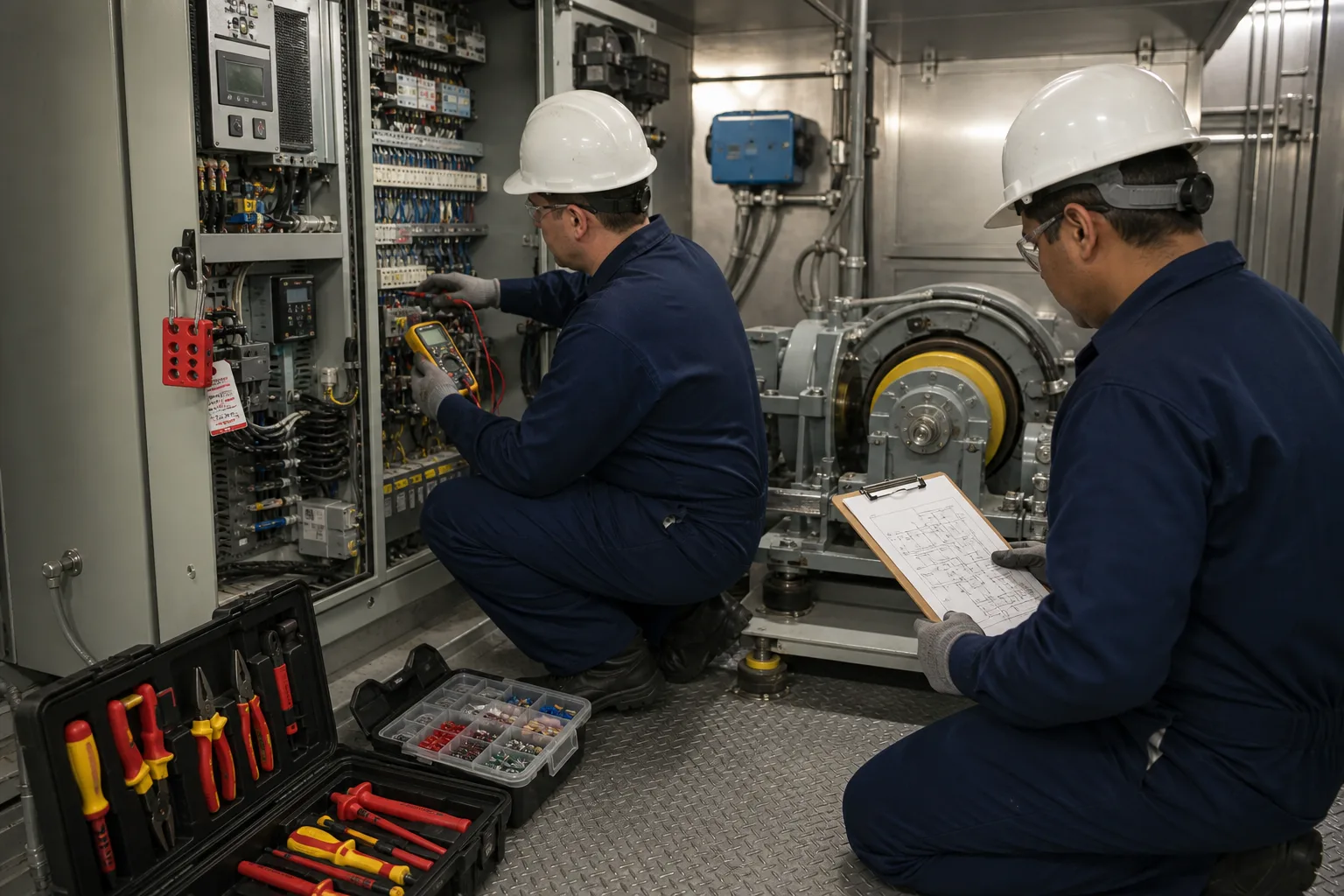
Technicians prepare insulated hand tools, multimeters, clamp meters, diagnostic instruments, computers and PPE. List make, model, quantity, serial number and battery status before gate filing.
Candidate spare-parts list
Use alarms, video, drawings and nameplates to shortlist parts. Confirm part number, specification, quantity, value, origin and whether each item will remain onboard or return ashore.
Customs and terminal treatment
Send ship-bound spares to the appointed agent or customs broker early. Chinese customs rules allow approved stores and safety spares to be added to an international conveyance, but the filing route is case-specific.
Identity and boarding dossier
Prepare identity details, the formally required boarding permit information, recent photographs, contact details and the final personnel list in the agent's format.
Technical competence evidence
Include relevant elevator or technical certificates and the employer assignment. Provide accurate translations where requested and do not overstate a certificate's title or scope.
Insurance and safety pack
Carry valid insurance evidence for everyone attending, together with PPE, risk assessment, method statement, lockout/tagout plan and vessel-specific safety documents.
05 / URGENT REPAIR VS ANNUAL INSPECTION
Urgent repair and annual inspection need different inputs
| Planning point | Urgent repair | Routine annual inspection |
|---|---|---|
| Trigger | State entrapment risk, isolation status, alarms, first occurrence and repeatability before mobilisation. | Confirm inspection basis, previous report, due window, elevator count and current operating status. |
| Technical evidence | Prioritise drawings, parameters, fault video, recent repairs and replaced parts. | Prepare the technical file, previous annual/survey records, maintenance logs and operation manual. |
| Spares strategy | Shortlist high-risk failed parts and decide whether to carry, source locally or plan a second attendance. | Inspection instruments normally lead; prepare corrective parts only where a known defect already exists. |
| Vessel support | Assign a technical crew member who has seen the fault and can support rapid isolation. | Assign at least one technical crew member for machinery-space, shaft, car-top, pit and functional tests. |
| Deliverable | Repair record, probable cause, parts changed, test evidence and open risk. | Inspection scope, findings, readings, corrective recommendations and the agreed report. |
06 / SCHEDULE CHANGE PROTOCOL
When the schedule moves, rebuild the attendance window
Aim to communicate a known change at least 48 hours ahead. If the berth plan moves inside that period, issue the update immediately rather than waiting for the 48-hour mark. Re-send the current schedule and agent contact, then reconfirm travel, permit validity, terminal filing, tool and spare manifests, and net working hours.
07 / FAQ
Yantian marine elevator service FAQ
Which ships normally call Yantian?+
YANTIAN is a deep-water container hub. Calls commonly include ultra-large deep-sea container vessels, large mainline ships and regional feeders. Attendance planning still depends on the actual gangway, elevator location, engine-room access and terminal window.
Is a master's invitation enough to board?+
No. It supports the business purpose of attendance. Personnel boarding a foreign vessel for repair work remain subject to immigration inspection and terminal clearance. The agent should confirm the permit name, validity and filing route for the specific call.
Do ordinary hand tools require customs entry?+
Routine carried tools and ship-bound spare parts should not be assumed to follow the same process. Send an itemised list to the agent. Customs treatment depends on the item's nature, value, origin, destination and whether it will leave China on the vessel or return ashore.
Can an engineer be booked before the berth is fixed?+
Remote triage and dossier review can start with a TBC berth. Gate route, vehicle filing and final boarding window should be reconfirmed as soon as the terminal plan is released.
What can make an annual inspection overrun?+
Access delays, unavailable drawings, unresolved safety defects, missing test arrangements, spare-part needs and a shortened berth window can all extend the job. Agree the decision path before attendance.
OFFICIAL REFERENCES / 资料依据
Sources and scope
- YANTIAN: company profile and facility data
- YANTIAN: facilities, quay length and water depth
- YANTIAN: West Port three-berth project
- YANTIAN: East Port Phase I development
- National Immigration Administration: permission to board foreign vessels
- China Customs: international conveyance supervision and stores
This guide supports planning and communication; it does not replace instructions from the port, terminal, immigration inspection, customs, class or flag administration. Berth, schedule, clearance and filing requirements must be reconfirmed for each call.
RELATED SHENZHEN PORT GUIDE
Also calling Shekou? Read the Shekou marine elevator repair and boarding guide
The Shekou guide focuses on schedule information, the master's invitation, agent coordination and boarding preparation across the Chiwan, Mawan and Shekou areas.
Read the Shekou port guide →