
The short answer: where a site has frequent outages or voltage disturbances and limited immediate rescue resources, an elevator ARD should normally be considered a priority project option. It must, however, be matched to the controller, drive and safety circuits. A battery label or a claimed 380 V output alone does not prove compatibility.
01 / FIELD GUIDE
What is an elevator automatic rescue device?
An automatic rescue device (ARD) is a backup system designed to provide limited emergency power and run a predefined rescue sequence when normal supply is lost. Where the elevator system and safety conditions permit, it moves the car to a floor at which passengers can be released, then leaves the rescue mode.
An ARD is not a standby generator and does not restore power to a building. Its output, rescue direction, compatible elevator type and permitted actions depend on the specific design.
02 / FIELD GUIDE
How does an ARD respond to a mains failure?
A typical rescue sequence follows the stages below. The actual order, speed and choice of landing depend on the ARD, elevator controller and site configuration.
Normal supply
Mains power runs the elevator and maintains the backup-battery system.
Failure detected
The device detects a supply abnormality and enters its designed emergency mode.
Backup transfer
The battery and power-conversion stage supply a compatible elevator drive.
Controlled leveling
The controller runs a limited, controlled rescue movement and verifies the landing condition.
Passenger release
The doors open only when the car reaches a permitted position; the rescue output then stops.
03 / FIELD GUIDE
Why give emergency rescue extra attention on African projects?
Power quality varies considerably between countries, cities and individual sites across Africa. It is more accurate to assess the project’s measured supply conditions than to treat the continent as one uniform grid. At a building with documented outages, undervoltage or voltage fluctuations, passengers may be trapped when mains power fails. If a technician cannot attend promptly, the wait and the building team’s workload can increase.
For elevator exports to Africa, an ARD can therefore provide an important layer of passenger protection during a power-related entrapment. It does not replace compliant elevator design, brakes and safety circuits, an emergency-response plan or trained personnel—and it should not be advertised as capable of rescuing in every fault condition. The project team should select the system using a site power survey, building conditions, use case and local requirements.
04 / FIELD GUIDE
ARD specification for elevator exports: six checks
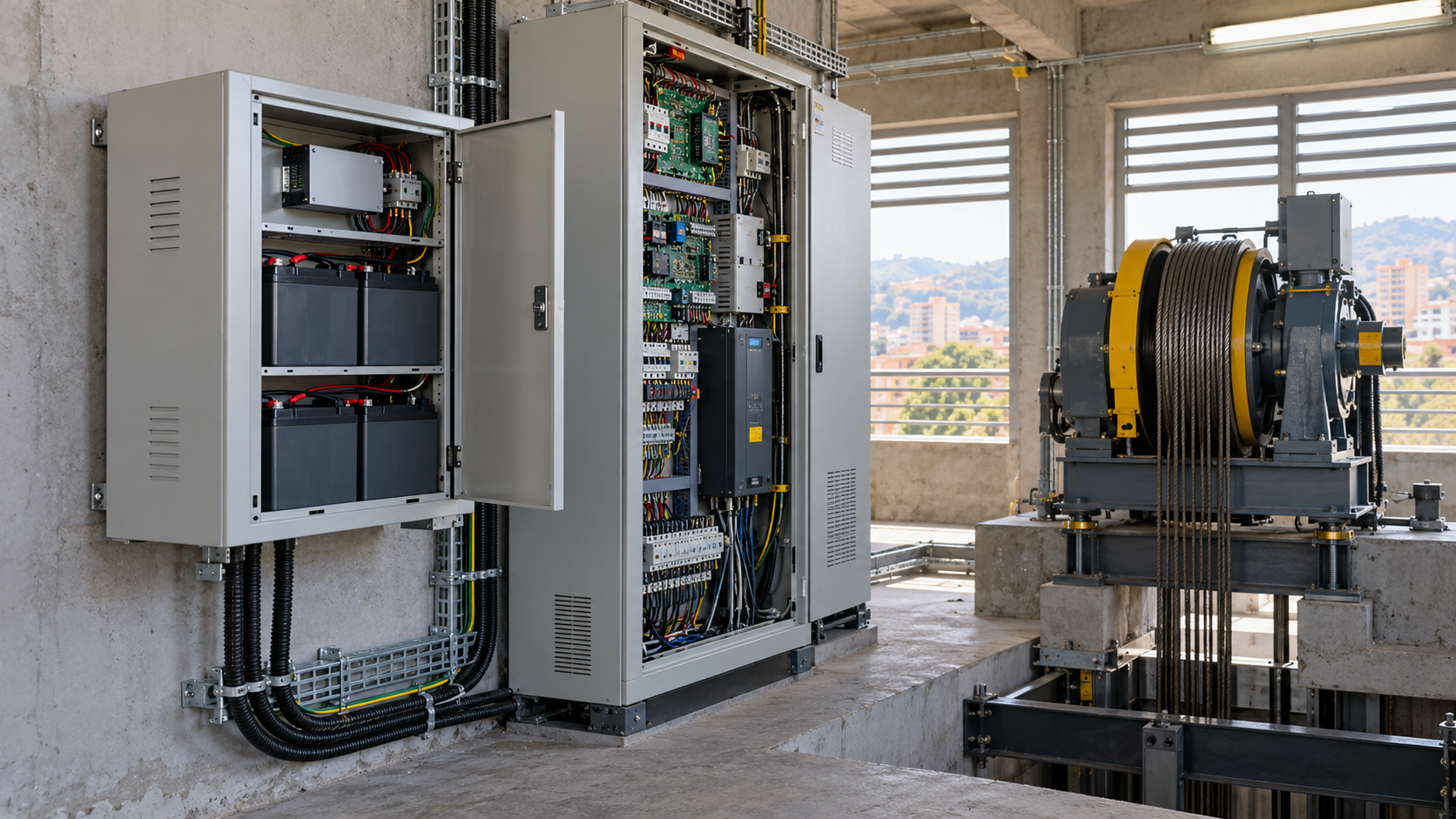
An elevator export or elevator parts export package should not stop at the traction machine, controller and car. The ARD must be checked as part of the complete electrical design, particularly to avoid mismatches in battery capacity, drive input, brake-release logic or control interfaces.
Site power profile
Collect evidence on outage frequency and duration, voltage range and three-phase supply; use project measurements and owner records.
System compatibility
Check the controller, drive, traction machine, brake and safety-circuit models and interfaces.
Power architecture
Confirm battery voltage, conversion method and output. Some systems convert backup power to a suitable AC supply; certain drives accept low-voltage battery input directly.
Rescue strategy
Define permitted direction, landing-selection logic, load limits, rescue speed and door-opening conditions.
Battery and environment
Verify battery type, capacity, temperature limits, ventilation and expected backup time against the manufacturer’s requirements; confirm replacement availability at destination.
Handover and training
Include schematics, terminals, fault indicators, test procedures and maintenance intervals in the handover pack, and train local maintainers.
This is a useful discussion when choosing an overseas elevator supplier: ask how the ARD interfaces with the control system, which items are included in the elevator parts export package, and how replacement modules or batteries will be supported in the destination market.
05 / FIELD GUIDE
How should an ARD be tested and maintained?
A two-monthly simulated rescue test, as proposed for this project, can be used as a maintenance-plan recommendation. It is not a universal statutory interval for every brand, model or jurisdiction. Battery chemistry, charging strategy and manufacturer requirements differ. Some manuals call for more frequent battery checks or specify a different interval for a simulated rescue. Follow the applicable manufacturer instructions, maintenance contract and local rules—using the stricter requirement where they differ.
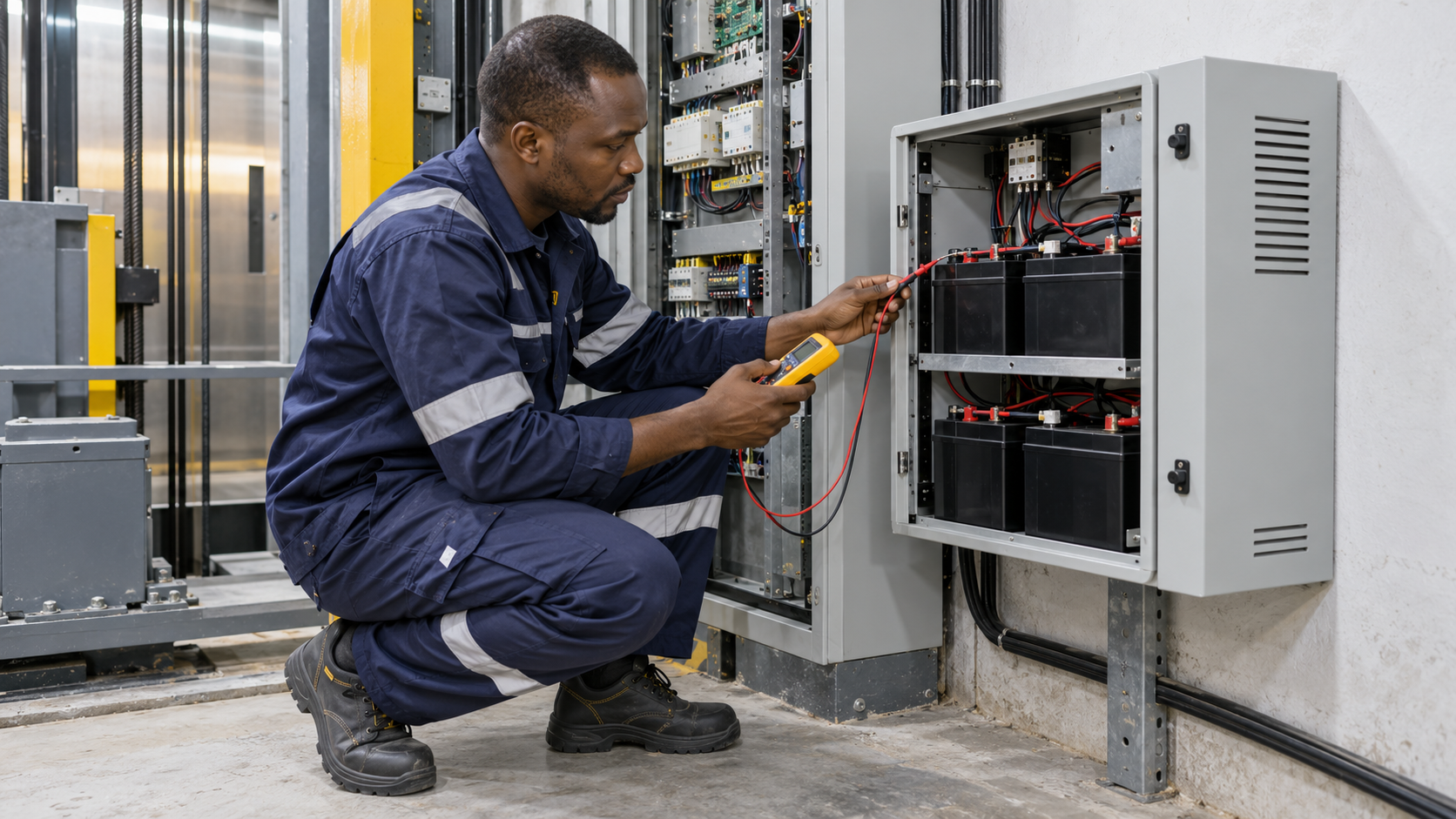
If a qualified elevator technician carries out a two-monthly test plan under an approved procedure, the work should at least cover:
- Inspect battery condition, connections, terminals, charging status and device fault indications.
- Use the manual’s power-failure simulation to verify transfer, rescue movement, landing detection, door release and return to normal mode.
- Record test conditions, results, defects and corrective action; restore mains power and confirm charging resumes.
- Establish an exclusion zone, keep passengers out of the car, notify the building team and never ask untrained staff to isolate the supply for a test.
Do not deliberately deep-discharge a battery just to “exercise” it. Whether continuous float charging affects service life depends on battery chemistry, temperature, charger design and management. Follow the manufacturer’s inspection and functional-test procedure rather than assuming every battery needs a full discharge at a fixed interval.
06 / FIELD GUIDE
Frequently asked questions
Will an ARD rescue passengers in every situation?+
No. It can perform its designed sequence only when its operating limits, backup capacity, control interfaces and safety conditions are met. Mechanical obstruction, fire, equipment failure or other abnormal events require the relevant emergency procedure.
Does every ARD raise battery voltage to 380 V?+
No. Some systems convert battery power to a suitable AC output, while certain drives accept low-voltage battery input. Confirm the architecture for the specific model and elevator design.
Is a test every two months mandatory?+
A two-month interval may be adopted for a particular project, but it is not a universal legal rule. Check the product manual, local requirements and maintenance contract; follow a shorter required interval.
What information is needed for a project quotation?+
Provide the elevator make and model, controller and drive details, measured supply conditions, building floors, outage history, desired rescue logic and local maintenance capability so the ARD and spare-parts package can be assessed.
FIELD NOTE
Plan for project reliability as a whole
For an African project exposed to unreliable power, discuss the ARD early in the elevator specification. A dependable solution is more than a battery pack: it requires a site power assessment, compatible drive and controls, validated rescue logic, replacement parts in the destination market, and a documented test schedule based on the applicable manual. KERUI can support elevator exports, elevator parts export planning and technical handover for overseas projects.
OVERSEAS PROJECT SUPPORT
Review ARD compatibility for your African project
Share the elevator model, controller/drive details, project country and site power conditions to discuss system compatibility and export spare-parts planning.
Technical references and scope
Inovance’s information for a particular elevator drive describes 48 V battery emergency-rescue support. This is an example of one product capability, not a universal ARD architecture. View Inovance product information.
A published HTK ARD battery instruction lists monthly battery checks and quarterly simulated rescue testing, illustrating that intervals vary by model. View the HTK ARD battery instructions. Always follow the applicable product manual and local requirements.